Preserving Kashmiri Pearl Poppers through controlled lactic fermentation.
Summary
Whole elephant-garlic corms are naturally built for long-term dormancy — so why destroy that structure to preserve them? This Lab Note explores controlled lactic acid fermentation as a preservation method for Kashmiri Pearl Poppers. LAB-X is used to acidify the fermentation medium, after which the corms are pasteurised and sealed for storage. The objective is straightforward: preserve the whole popper while retaining its distinctive structure and naturally occurring chemistry.
1. The Corm: Nature’s Storage Package
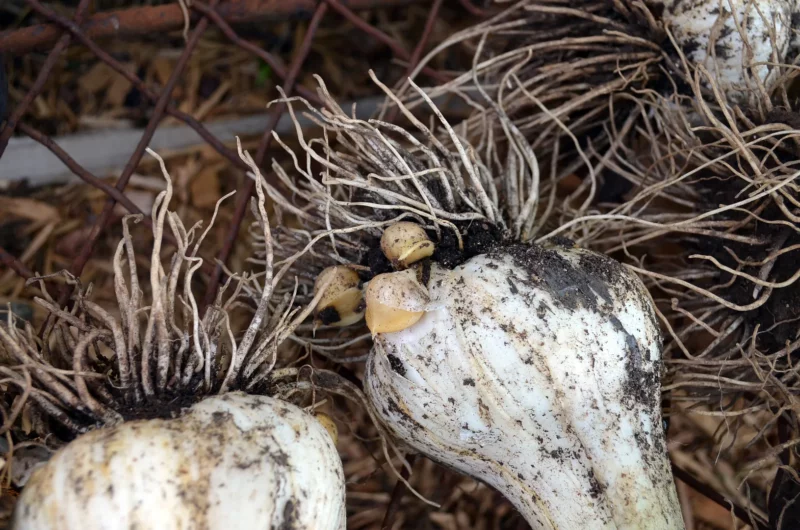
Elephant garlic corms, often known as “Kashmiri, Himalayan or Snow Mountain Garlic,” are remarkable biological structures. Unlike ordinary garlic cloves, which are relatively hydrated and soft, elephant-garlic corms are surprisingly dense and hard, protected by their dry outer tunic. As explored in Elephant Garlic Corms: The Hidden Chemistry & SAC | 107N, these corms are nature’s own survival packages. They are dense storage organs designed by the plant for dormancy and resilience, capable of remaining viable for extended periods under suitable conditions.
This inherent durability leads to a practical engineering question:
If nature has already built such an effective storage structure, perhaps our preservation efforts should work with the corm rather than against it.
Instead of immediately processing these corms into an extract, the goal here is to preserve the whole, intact object, leveraging its natural design for long-term stability.
2. Why Lactic Acid Fermentation for Preservation?
Lactic acid fermentation is one of the oldest and most effective biological preservation technologies known. Its utility stems from the ability of Lactic Acid Bacteria (LAB) to convert fermentable carbohydrates into organic acids, primarily lactic acid.
For the preservation of Kashmiri Pearl Poppers, the mechanism is straightforward:
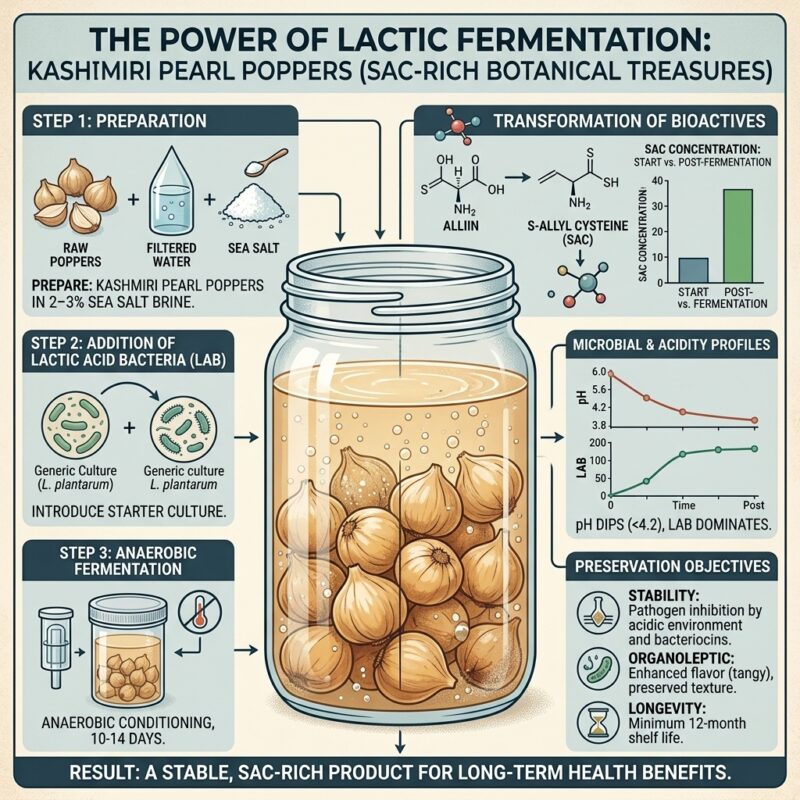
LAB Consumes Carbohydrates: Our LAB-X starter culture is introduced into a brine containing water and a fermentable carbohydrate (dextrose). The LAB metabolize this sugar.
Lactic Acid Production: As the LAB grow, they produce lactic acid.
pH Falls: The accumulation of lactic acid rapidly lowers the pH of the fermentation medium, creating an acidic environment.
Suppression of Spoilage: This low pH is a powerful natural antimicrobial, effectively suppressing the growth of undesirable spoilage microorganisms and pathogens.
Importantly, the objective here is not to create a live probiotic product. The LAB is being used as a processing organism to achieve a stable, acidic environment. Once the desired acidic endpoint is reached, a subsequent pasteurisation step stops the biological process, ensuring a microbiologically stable and safe product. This combined approach allows us to harness the benefits of fermentation while providing robust control over the final preserved corms.
3. The Kashmiri Pearl Popper Preservation Recipe
This protocol describes the experimental setup for preserving whole elephant garlic corms through controlled lactic acid fermentation. The experiment is deliberately designed to preserve the whole popper, without crushing or mechanical disruption.
Starting Material:
Whole, clean elephant garlic corms (Kashmiri Pearl Poppers).
Fermentation Medium Formulation (per 1000 mL water):
Water: 1000 mL
Dextrose: 20 g (1% by volume)
LAB-X (fermentation starter): 10 mL (1% by volume)
Process Steps:
1. Prepare Fermentation Brine: In a clean vessel, combine the water, dextrose, and LAB-X. Mix thoroughly until the dextrose is fully dissolved.
2. Prepare Corms: Select clean, unblemished elephant garlic corms. Do not crush or mechanically disrupt them.
3. Fill Media Jars: Place the whole corms into clean, sterilized media jars.
4. Add Fermentation Brine: Pour the prepared brine over the corms, ensuring they are completely submerged. Leave adequate headspace (e.g., 1-2 cm) for gas expansion.
5. Ferment: Seal the jars and place them in a controlled environment at approximately 30–35°C.
- Monitoring: Monitor pH, appearance (e.g., gas production), and aroma during fermentation.
- Endpoint: The endpoint is determined by acidification to a selected preservation pH, rather than simply by elapsed time. Initial fermentation window: approximately 7–10 days.
6. Finishing and Sealing: Once the desired acidic endpoint is reached, the fermented corms are pasteurised. This step removes the active microbial population. After pasteurisation, the jars are immediately sealed and allowed to cool for storage. Additional preservation hurdles can be incorporated if required for specific shelf-life targets.
4. Why Preserve the Whole Popper?
The objective of this process is distinct from manufacturing a garlic extract. By preserving the whole Kashmiri Pearl Popper, we aim to retain its unique physical and chemical characteristics:
Intact Structure: The corm retains its original form, including its protective tunic and dense internal structure.
“Popper Experience”: This allows the consumer to experience the whole corm, rather than a processed extract.
Retained Chemistry: The inherent chemistry of the corm, including stable compounds like S-allyl-L-cysteine (SAC) (as discussed in 107N), is preserved within its natural matrix. While fermentation introduces chemical transformations, the goal is to retain these beneficial compounds within the whole food structure.
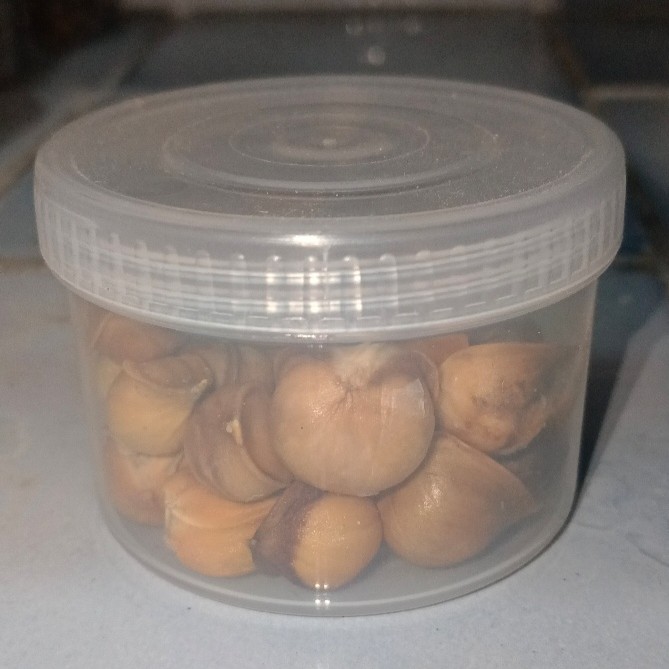
This approach offers versatility: the customer can remove the softened, preserved corm and consume it whole, or they can choose to crush it immediately before use if they desire to introduce mechanical disruption and potentially activate different compounds at the point of consumption. This bridges the gap between a raw ingredient and a processed extract, offering a unique product experience.
5. Pasteurisation: From Fermentation to Preservation
The fermentation process, driven by LAB-X, is deliberately allowed to achieve the desired acidification. However, for a shelf-stable product, this biological activity must then be controlled.
Fermentation Finished: Once the target pH is reached and the fermentation process has created the necessary acidic environment, the biological transformation phase is complete.
Pasteurisation: The sealed jars containing the fermented corms undergo pasteurisation. This heat treatment effectively inactivates the active microbial population (including the LAB-X) and any enzymes, halting further fermentation or spoilage.
Sealed Container: The subsequent sealing of the container prevents re-contamination, ensuring the product’s microbiological stability.
This two-stage process – controlled fermentation followed by pasteurisation and sealing – is the engineering story of how we transform a raw corm into a stable, preserved product. The result is a whole, shelf-stable Kashmiri Pearl Popper, ready for consumption.
Conclusion:
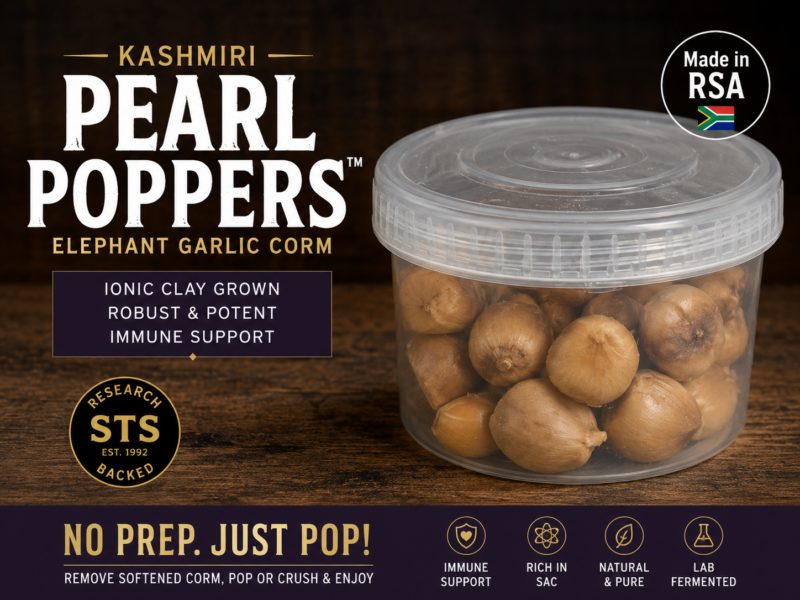
This experiment is based on a simple idea: if an elephant-garlic corm is already designed for long-term biological storage, preserve the corm rather than processing it out of existence. Lactic fermentation provides the initial preservation mechanism through acidification, while pasteurisation provides the finishing control and microbiological stability. The result is intended to be a shelf-stable version of the whole Kashmiri Pearl Popper, distinct from a garlic extract.
The remaining work is empirical: establish the optimal fermentation endpoint (pH), confirm pH stability over time, verify microbiological stability, and determine how this specific whole-corm fermentation and pasteurisation process affects the corm’s naturally occurring S-allyl-L-cysteine (SAC) and other organosulfur chemistry.
-
STS
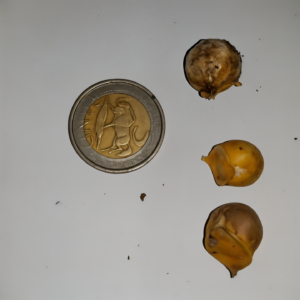
Organic Elephant Garlic Corms (Heirloom)
Original price was: R135.R95Current price is: R95. Add to basket🌱 Start your Elephant Garlic journey.
🌱 Grows into Ajo Macho Solo Round.
🌱 Perennial plant and natural pest deterrent.
🌱 Limited Stock – 20 off per pack -
STS
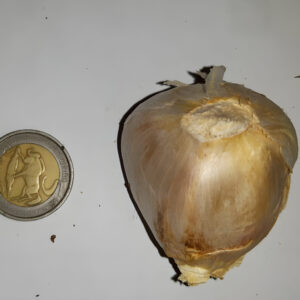
Organic Elephant Garlic Cloves – Vernalized
Original price was: R695.R495Current price is: R495. Add to basket🌱 Large, mild-flavoured cloves
🌱 10 Elephant Garlic Organic seeds
🌱 Vernalized for immediate planting
🌱 Seasonal – limited Stock -
STS

Eco Bini™ BioaKt Media/Substrate Conditioner | 2000 ml
Original price was: R195.R149Current price is: R149. Add to basket🏗 Bundu-Tek additive with kelp alginates – No autoclave needed.
🏗 Alkaline pH Pasteurizer
🏗 Self-sterilizing formula
🏗Boost yields and colonizing times -
STS
Alpha & Omega [Kratky & Passive Hydro] Nutrient Kit – 2x 500ml
Original price was: R195.R95Current price is: R95. Add to basket🛠 Dual-part liquid Kratky hydroponic nutrient concentrates
🛠 Refined Hoagland solution pre-dissolved in 2x 500ml UV-opaque white bottles
🛠 perfect for passive indoor herb gardens — Just Dose and Grow
Socratic Questions:
1. How does lactic acid fermentation preserve whole garlic corms?
2. Can elephant garlic corms be fermented without crushing them?
3. What pH is needed to preserve fermented garlic safely?
4. Does pasteurisation affect SAC in fermented garlic?
5. How long can fermented elephant garlic corms be stored?