Unlocking Nature’s Resilience: Elephant Garlic Corms & Their Enduring Power.
Summary
These dense, protective structures, often overlooked, are packed with stable, beneficial compounds. Research highlights their rich content of saponins, glycosides, and the unique organosulfur compound S-allyl-L-cysteine (SAC), demonstrating notable and persistent antifungal activity. This exploration delves into the survival chemistry of elephant garlic corms and their potential for innovative applications.
1. The Little Corm Built to Wait
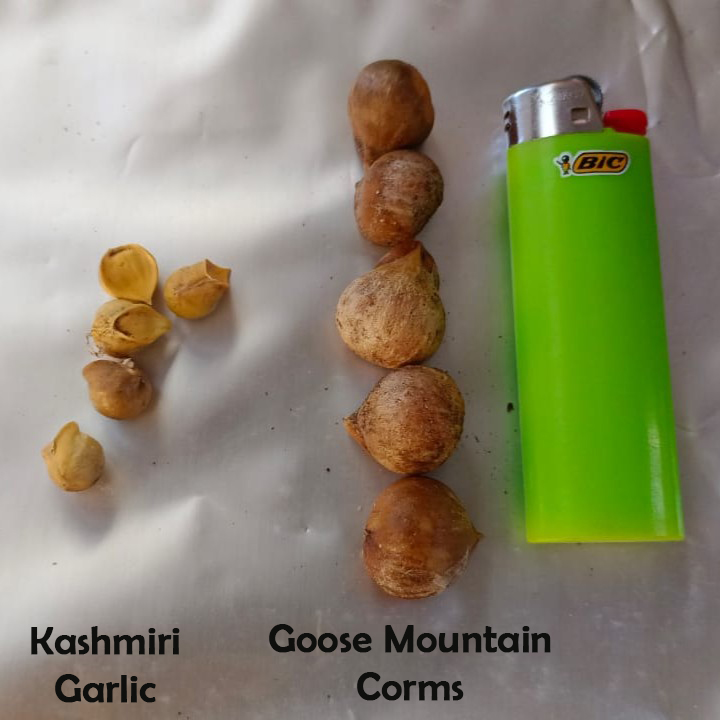
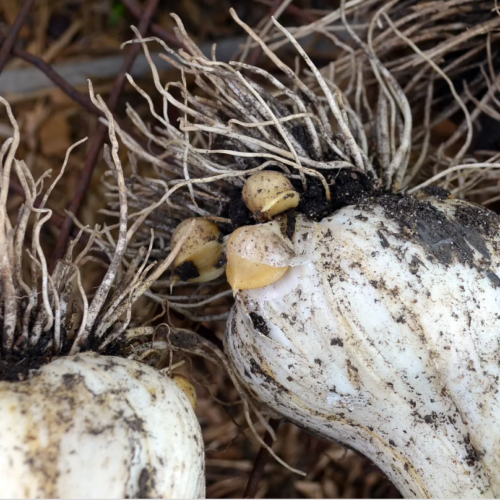
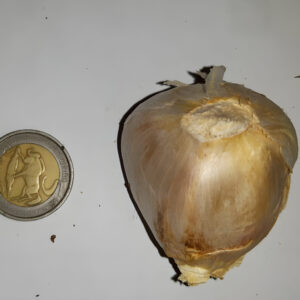
Elephant garlic (Allium ampeloprasum var. ampeloprasum) is usually grown for its enormous bulbs, but around the base of those bulbs is something much smaller and, in many ways, more interesting: the corm. Corms are the small, hard, nut-like propagation structures that form around the base of an elephant garlic bulb. They are not simply miniature cloves. A mature corm is a compact storage organ surrounded by a tough protective tunic, designed to remain dormant until conditions are suitable for growth.
Anyone who has handled elephant garlic corms quickly notices the difference. They are surprisingly dense.
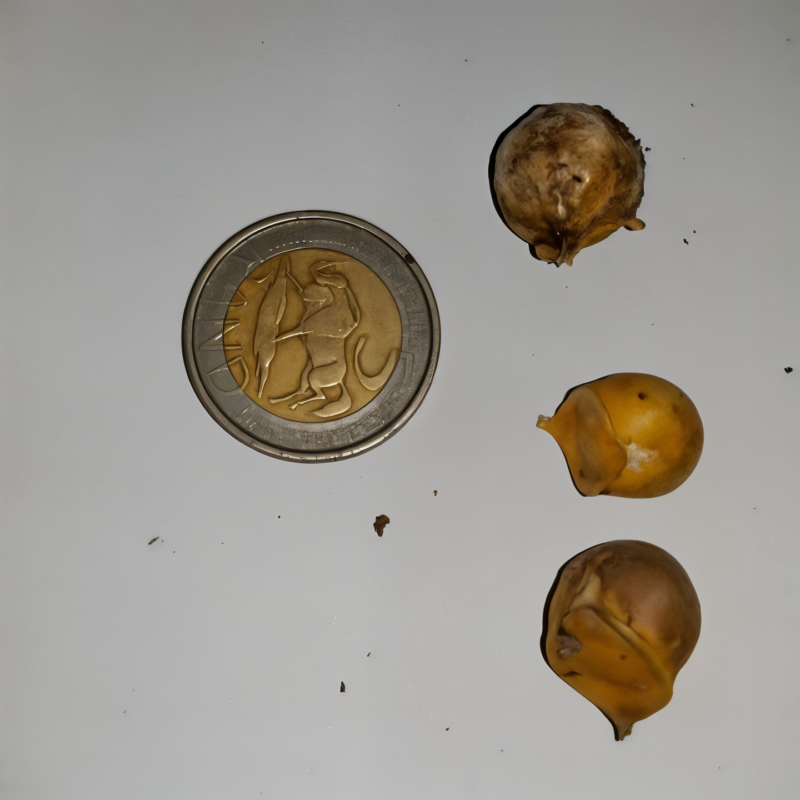
Ordinary garlic cloves have a relatively soft, hydrated structure and can even float depending on their size and condition. Elephant garlic corms are another matter: drop one into water and it tends to sink with a satisfying little “plop.” Even after peeling away the outer protection, the tissue remains remarkably compact.
That physical density makes sense when the corm’s real job is considered. The corm is an insurance package for the plant. It has to survive drying, storage, burial and unfavourable seasons before eventually producing a new plant. The protective outer tunic provides a first line of defence, while the dense internal tissue stores the resources required for germination. This is also why elephant garlic corms can behave very differently from ordinary seed material. Under suitable conditions they can remain dormant for extended periods before germinating. Practical observations with elephant garlic propagation, including the behaviour of corms such as those associated with the Ajo Macho (Elephant Garlic Rounds), demonstrate that dormancy can be surprisingly long: the corm is not necessarily trying to grow immediately after it enters the soil.
That changes how we should look at it. A corm that can sit underground through an unfavourable period without simply rotting has a very different biological problem to solve from a fresh garlic clove intended for immediate growth. It needs protection, storage and controlled release of resources. And that leads directly to the chemistry.
The usual conversation about garlic chemistry concentrates heavily on the fresh clove and, particularly, allicin. Crush true garlic, allow the enzyme alliinase to act on alliin, and a highly reactive group of sulfur compounds is produced. This chemistry is fascinating, but it is only one part of the Allium story. The elephant garlic corm gives us another angle. Instead of asking only how to generate the maximum amount of short-lived allicin, we can ask: What compounds are stored in this remarkably durable little organ, and what happens when those compounds are extracted? That question becomes particularly interesting when we look at Himalayan “Kashmiri garlic.”
2. The Himalayan “Kashmiri Garlic” Connection & DIHAR Discoveries
The name Kashmiri, Himalayan, Snow Mountain garlic or even Ek pothi lahsun can create some confusion because garlic names are often used rather loosely—especially for Elephant Garlic.
One particularly interesting piece of research from the Defence Institute of High Altitude Research (DIHAR) investigated what it describes as Himalayan or Kashmiri garlic, locally known as Ek pothi lahsun. The important point for elephant-garlic research is that the study identifies its material as: Allium ampeloprasum var. ampeloprasum—elephant garlic. The researchers describe this material as a perennial, tuberous plant associated with the Jammu & Kashmir region and high-altitude environments.
So the romantic descriptions of a mysterious “Himalayan garlic” need a little unpacking. The study isn’t telling us that every product sold as Kashmiri garlic is automatically elephant garlic, nor that every elephant garlic plant worldwide is genetically identical to the Himalayan material. What it does establish is much more useful: A population identified as Kashmiri or Ek pothi lahsun in the Himalayan region was identified by the researchers as elephant garlic.
And the researchers weren’t interested merely in its ability to grow at altitude. They investigated what was actually inside the corm. They prepared an aqueous extract using peeled corms. The corm material was homogenised with water, macerated, filtered and processed for analysis. The preliminary phytochemical screening found several classes of compounds, including:
- Carbohydrates
- Glycosides
- Alkaloids
- Saponins
The elephant-garlic/Kashmiri material showed particularly strong representation of saponins in the screening compared with the normal garlic material used as a comparison. Then came the finding that is particularly relevant to our later discussion: S-allyl-L-cysteine (SAC) was identified in the aqueous corm extract using chromatographic analysis. That is significant because SAC belongs to a much more stable and water-soluble part of garlic’s organosulfur chemistry than the rapid burst of reactive compounds associated with freshly crushed garlic.
But the DIHAR researchers didn’t stop at chemistry. They also asked whether the corm extract actually did anything biologically measurable.
The Antifungal Test:
The aqueous corm extracts were tested against three Candida species: Candida albicans, Candida tropicalis, and Candida glabrata. The extracts demonstrated in-vitro antifungal activity against all three organisms. The particularly interesting observation was persistence. Against C. albicans, the Kashmiri garlic extract continued to produce measurable zones of inhibition at 48 hours at several concentrations. The ordinary-garlic extract, by comparison, had fallen to zero measurable inhibition at those same concentrations. For example, at 40 mg/mL, the Kashmiri extract produced a 13.3 mm inhibition zone at 24 hours and still produced 10.7 mm at 48 hours. The normal garlic extract went from 10.0 mm at 24 hours to 0 mm at 48 hours. At 60 and 80 mg/mL, the same general persistence was observed. That does not mean that elephant garlic is “twice as antifungal” as ordinary garlic. The experiment does not establish that. The more interesting and defensible observation is: Under the test conditions, the Kashmiri elephant-garlic corm extract retained measurable antifungal activity for longer than the normal-garlic extract. Similar testing against C. tropicalis and C. glabrata also demonstrated measurable inhibition and persistence at 48 hours at several concentrations.
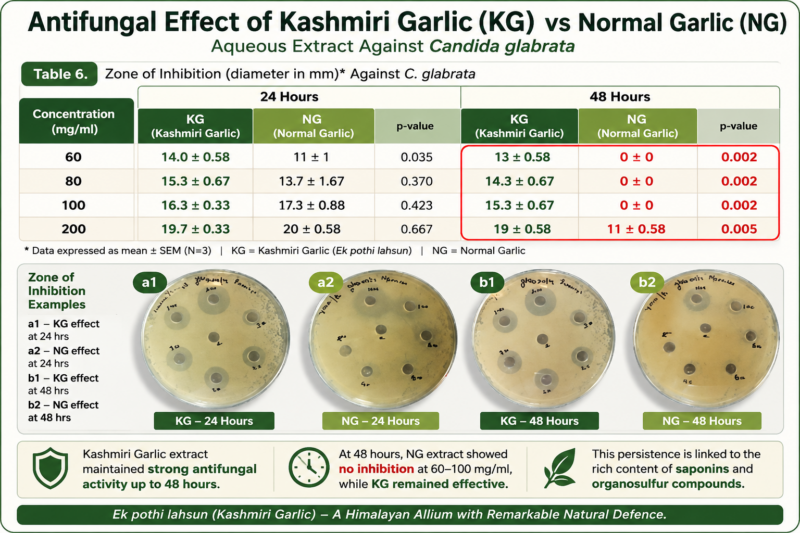
The researchers discuss the possible contribution of polar organosulfur compounds and saponins, but the study does not establish that SAC alone is responsible for the antifungal effect. That distinction matters. The DIHAR study gives us something much better than a marketing claim. It gives us a starting point: A remarkably durable elephant-garlic propagation organ contains water-extractable phytochemicals, including SAC, and its aqueous extract demonstrates measurable biological activity in vitro.
Corms and Cloves — Similar Plant, Different Job
| Aspect | Elephant Garlic Corms | True Garlic Cloves |
|---|---|---|
| Main Compounds | High saponins, SAC, glycosides | High allicin (when crushed) |
| Stability | Very stable, long shelf-life | Volatile, breaks down quickly |
| Antifungal Strength | Stronger in study vs normal garlic | Good, but shorter duration |
| Flavour when used | Milder, sweeter | Pungent |
| Traditional Use | Long-term storage, high-altitude tonic | Fresh culinary & medicinal |
And that distinction is where the story gets interesting. The corm is not simply a tiny garlic clove. It is a survival structure, and its chemistry appears to reflect that different biological role. The next question is therefore not simply “How much allicin can we get from elephant garlic?” It is: What is the role of SAC and the other polar compounds in this unusually durable Allium storage organ—and what happens to them when we process the corm?
3. Why SAC Changes the Elephant Garlic Story
If allicin represents the fast chemistry of freshly damaged garlic, S-allyl-L-cysteine (SAC) represents something quite different. SAC is a water-soluble organosulfur compound found in garlic and garlic-derived preparations. Unlike allicin, it is relatively stable and does not depend on the moment of crushing for its existence. That makes SAC particularly interesting in a corm.
The DIHAR study detected SAC directly in its aqueous elephant-garlic corm extract. This is important because the researchers were not using an exotic solvent or complicated extraction sequence: they were working with water and the peeled corm. It also changes how we should think about processing elephant garlic. If the objective is purely to maximise allicin, the obvious strategy is to crush the tissue and carefully manage the short-lived enzymatic reaction that follows. But if the objective includes SAC and other polar compounds, then aggressive processing is not necessarily the answer. The chemistry becomes a question of preservation and transformation.
This is particularly relevant because garlic processing can change the relative abundance and form of its organosulfur compounds.
Fermentation, ageing, heating, drying and extraction are not chemically neutral operations; each can shift the composition of the resulting preparation. The DIHAR study therefore gives us a useful baseline: Elephant garlic corms already contain SAC before we do anything particularly clever to them. That is an important distinction. We don’t need to invent SAC as a consequence of our processing. We first need to understand how much is present, how much survives processing, and whether fermentation changes its availability.
4. From Corm to Fermented Extract: The LAFEGE Process
This leads directly to the next stage of the Bundu Teq investigation. A conventional garlic extraction approach might be designed around capturing a particular compound. LAFEGE takes a different approach: the corm is mechanically disrupted, extracted into water and subjected to controlled lactic-acid fermentation. The LAB fermentation therefore becomes another transformation stage between the original corm and the final extract.
We currently know that:
Elephant garlic corms → contain SAC and other polar phytochemicals
Aqueous extraction → can recover at least some of those compounds
LAB fermentation → changes the chemical environment through acidification and microbial metabolism
What we do not yet know is exactly what happens to SAC during our LAFEGE process. That is an important research boundary. We should not claim that fermentation increases SAC until we actually measure it. Equally, we shouldn’t assume that fermentation destroys it. The sensible approach is to treat the existing DIHAR result as the starting reference point and investigate what controlled fermentation does to the extract. This is where the old allicin-centred model of elephant garlic processing gives way to a broader one: Don’t just chase the compound that appears immediately after crushing. Understand the chemistry that the corm has already evolved to store.
The corm’s remarkable physical durability, its ability to remain dormant, its dense protected structure and its unusual aqueous phytochemical profile are all pieces of the same biological puzzle. We don’t yet have all the answers. But we now have a much better question.
5. Conclusion: Unlocking the Corm’s Potential
Elephant garlic corms are easy to overlook because they are small and normally treated as nothing more than planting material. Yet their biology suggests something quite different: they are compact survival structures, built to protect stored resources until conditions are right for a new plant. The DIHAR research adds chemistry to that observation. Himalayan Ek pothi lahsun, identified in the study as elephant garlic, produced an aqueous corm extract containing saponins, glycosides and S-allyl-L-cysteine, while also demonstrating persistent in-vitro antifungal activity against Candida* species.
This foundational understanding of the corm’s inherent chemistry, particularly the presence and stability of SAC, opens new avenues for innovative applications. By moving beyond conventional garlic processing, Bundu Teq aims to harness the unique properties of these resilient corms, exploring how controlled fermentation can further optimize their beneficial compounds for sustainable, bio-inspired solutions.
-
STS
Eco Bini™ BAC: Complete Soil Biome Inoculant
Original price was: R229.R164Current price is: R164. Add to basket🛠Activated BAM! Dry Inoculant
🛠Add Sugar & Water to Activate
🛠High-Density Microbial Matrix
🛠Makes 600L+ Living Probiotic -
STS
Alpha & Omega [Kratky & Passive Hydro] Nutrient Kit – 2x 500ml
Original price was: R195.R95Current price is: R95. Add to basket🛠 Dual-part liquid Kratky hydroponic nutrient concentrates
🛠 Refined Hoagland solution pre-dissolved in 2x 500ml UV-opaque white bottles
🛠 perfect for passive indoor herb gardens — Just Dose and Grow -
STS
Organic Elephant Garlic Cloves – Vernalized
Original price was: R695.R495Current price is: R495. Add to basket🌱 Large, mild-flavoured cloves
🌱 10 Elephant Garlic Organic seeds
🌱 Vernalized for immediate planting
🌱 Seasonal – limited Stock -
STS
Binary Hydroponic Nutrient Kit – 2 x 5L Concentrates
Original price was: R275.R149Current price is: R149. Add to basket🌱 Makes 2 x 5L professional nutrient concentrate
🌱 Binary Alpha & Omega formula prevents nutrient lockout
🌱 Complete macro & chelated micronutrients
🌱 Professional hydroponics made simple
Socratic Questions
1. How can elephant garlic corms be used for natural antifungal solutions?
2. What are the health benefits of S-allyl-L-cysteine (SAC) in garlic?
3. Does fermenting elephant garlic increase its beneficial compounds like SAC?
4. Where can I buy Kashmiri garlic corms for planting or consumption?
5. What is the difference between elephant garlic and true garlic for health?