DIY – Recycle waste and reduce initial hydroponic setup costs by 80% and electrical consumption by 90%.
Summary
This Lab Note details the engineering genesis of a hybrid NFT-Bato design built entirely from recycled bottles and reused pine batons. It outlines the fluid dynamics of a 30° gravity tilt that enables a low-frequency pumping schedule to completely mitigate grid load-shedding failures. Readers will discover how this exact architecture served as the launchpad for the Eco Bini™ discovery of true organic Hydroponics, or Vermiponics.
1. The Genesis Sabbatical: From Owls Pub to the Backyard
After “retiring” from my international travels and selling “Owls Pub” in 2018, my thoughts returned to my post-graduate studies in Renewable Energy Systems, completed at the Sustainability Institute at my alma mater, Stellenbosch University, back in 2011.
Eco Bini (Pty) Ltd had been founded in 2017—with “Bini” meaning Building in Maltese—with the explicit vision of instilling sustainability initiatives not in the distant commercial sector, but right where we require it most: our homes.
Though electricity was in my bones from executing various large-scale projects across multiple countries over 20 years, South Africa was firmly in the throes of severe load-shedding. Looking out into the largely undeveloped backyard of my house, I remembered the community garden projects we started in the early mornings during the RE course.

And so my sabbatical began—not in energy generation, but in growing food.
I immediately looked toward Controlled Environment Agriculture (CEA) and hydroponics. Heading into the unknown with reckless abandon, I was genuinely shocked by the commercial costs of a basic Nutrient Film Technique (NFT) system. The mechanical engineer in me took over: What about using plastic bottles?
Implementing the classic motto “Reduce, Reuse, Recycle” led to an intriguing idea: why not reuse liquid packaging? I had plenty of 2L Coca-Cola bottles on hand—the remnants from those late-night hospitality escapades could finally be repurposed effectively! This system, through all its variations, takes only a single day to build. Yet a decade later, I am still running the Version 2 prototype. It was this exact trash-heap experiment that unlocked true “Organic Hydroponics.”
2. Making Food From Your Trash: Mechanical Layout & Fluid Dynamics
IInstead of paying for costly commercial NFT gutters, I realized I could simply drill a hole in the bottom of a 2L soda bottle and lay them end-to-end to create a proprietary “gutter-pipe.” By angling this bottle assembly, the bottles didn’t even require glue or sealant; the neck and cap area of one bottle inserted snugly into the 32mm hole saw cut of the next base, utilizing pure mechanical friction to maintain a continuous flow with zero spillage.
The assembly logic is straightforward:
- Use a 32mm hole saw to carefully cut an opening into the absolute bottom center of a clean 2L plastic bottle.
- The neck of the adjacent bottle fits tightly inside this opening.
- The very first bottle at the top of the chain does not get a wide base cut; it receives a small 5mm hole to accept the nutrient feed tube snugly.
- Cut a dedicated planting window into the side of each bottle body to accept your net pots and media.
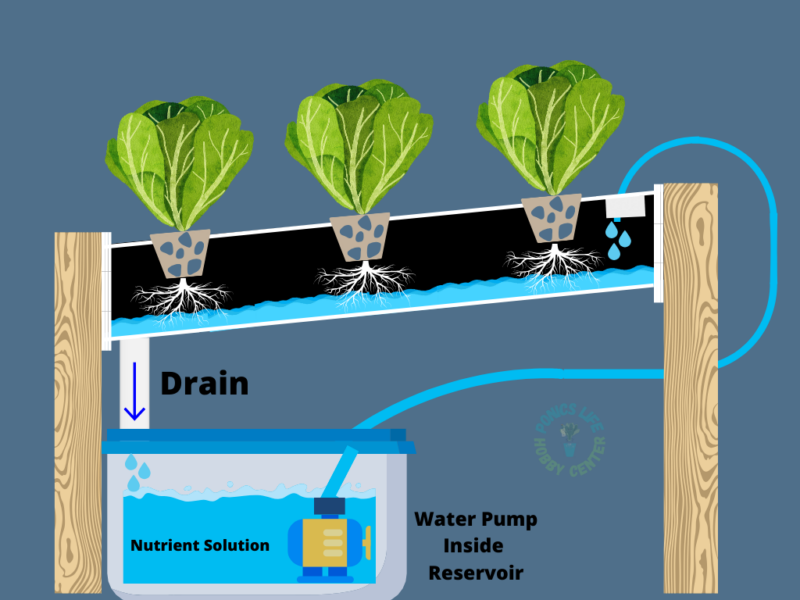
My original Version 1 design utilized old abalone cultivation tanks rescued from local dumps (highly similar to a standard geyser drip tray). I simply laid the interlocked bottle strings face-down in the tray at an angle. A distribution manifold fed nutrient solution directly to the 5mm inlets of the topmost bottles via microjet lines, and the discharge water collected at the bottom of the tray, draining back into a central reservoir to complete the loop.
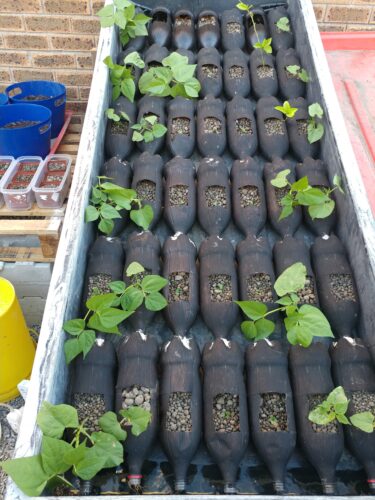
I chose to slant the system framework at a 30-degree angle. Sitting down here in the Western Cape at roughly latitude, this tilt allowed the plants to face the sun almost completely perpendicularly during peak growing seasons.
But then a piece of plain engineering luck—or eternal optimism—revealed itself. Because of the 30-degree tilt and the natural geometry of a soda bottle’s shoulder, a distinct collection hollow is formed in the downward-facing bottle necks. When the pump turns off, the water does not drain completely dry like a traditional NFT gutter. Instead, each bottle holds a localized, critical reserve pool of moisture and nutrients right beneath the root zone.
Suddenly, we had a Bottom-Feed Bato (Dutch Bucket) hybrid. If the power drops during a load-shedding block, the roots never dry out. Because of this built-in safety buffer, continuous pumping is completely unnecessary. I only pump 4 times a day in winter and 6 to 8 times a day in the heat of summer. This structural modification instantly slashes water pump electrical consumption by 90%.
3. The Soda Bottle Rack System V2 Upgrade
The flat-tray Version 1 prototype did not last very long—just about long enough for my initial test beans to sprout. The primary issue was spatial efficiency; lining the bottles flat and tight next to each other in a tray severely hampered lateral plant growth. However, trying to manually spread them apart caused the bottle lines to become top-heavy and roll over. This prompted the engineering of Version 2.
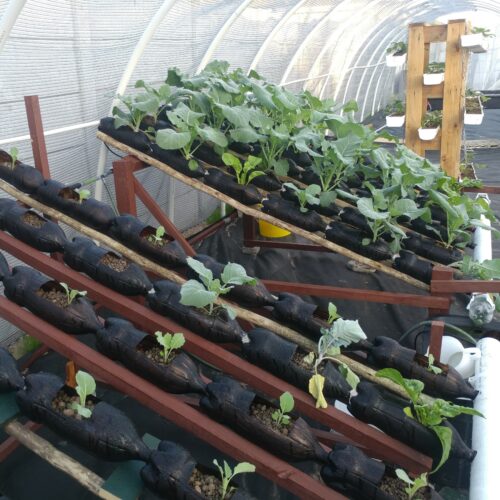
In the enhanced V2 framework, spatial distribution was perfected using scrap timber battens and treated pine fencing droppers:
- Structural wooden droppers are mounted on either side of each bottle string, creating a rigid 10cm channel that securely supports the bottle bodies and prevents rolling.
- The centerlines of each parallel bottle string are spaced exactly 30cm apart, establishing a highly uniform 30cm x 30cm structural grid for plant canopy development.
- Both the timber frame and the exterior of the plastic bottles receive a comprehensive coat of Acrylic Waterproofing Paint. This drastically extends the life of the wood, protects the plastic from UV degradation, and blacks out light penetration into the root zone—completely stopping algae formation in its tracks.
The upgraded inlet manifolds are constructed from black agricultural HDPE pipe, with flexible 5mm microjet tubing inserted directly into the top bottle bases. At the base of the entire rack, a standard residential PVC roof gutter collects the discharge from the lowest bottle necks, cleanly returning the water to the reservoir. This open gutter design makes it incredibly easy to visually monitor return flows and instantly flag if a microjet line has suffered a debris blockage.
Because the V2 footprint is so compact, it is uniquely suited for full automation. We previously experimented with a custom “Hydropino” system (an Arduino microcontroller paired with a simple capacitive fluid sensor mounted in the upper master bottle), which completely automated pump cycling based on moisture drop rather than a rigid mechanical timer, offering true hands-free off-grid operation.
CRITICAL MAINTENANCE UPDATE: Based on extensive operational field testing, we implemented a massive improvement by installing a simple, slightly open bypass valve at the absolute end of the main HDPE inlet manifold, which vents directly back into the reservoir. This continuous bypass loop allows small organic debris to cycle naturally back to the main tank rather than being forced down the lines, drastically reducing microjet blockages.

The Pillars of the STS Paradigm
Before looking at how this system changed the game for organic cultivation, it is vital to understand where this hardware sits in the broader multi-pillar sustainability ecosystem:
4. The Vermiponics Breakthrough & Elephant Garlic Proof of Concept
Beyond recycling efficiency and severe power grid protection, the true legacy of the CBB-Tek system is its fundamental versatility in helping us master organic hydroponics.
Standard commercial Controlled Environment Agriculture relies strictly on synthetic mineral salts (like the classic Hoagland Solution). It is widely accepted industry knowledge that you cannot run complex organic fertilizers in high-performance hydroponics. Why? Because raw organic matter creates an unmanaged bacterial explosion, forming a thick, stubborn biological biofilm that instantly chokes feed tubes, clogs manifolds, and burns out water pumps.
Overcoming this limitation was an exhaustive engineering quest (which we document deeply in our upcoming companion paper, “The Search for True Vermiponics“). The solution was ultimately pioneered right inside this humble, recycled bottle loop.
Because the liquid trickles along the bottom slope of the interlocked bottles while leaving the plant containers to wick moisture upward, the CBB-Tek naturally operates as a localized bottom-feed wicking system. This allowed us to physically isolate the intense biological digestion process away from the narrow plastic plumbing lines.
By completely replacing inert commercial hydro media with an active organic blend—initially composed of 30% pure vermicompost, 10% vermiculite, and 60% aged, weathered sawdust—we successfully ran the entire plumbing network on plain water.
This layout activated the two core pillars of the STS philosophy:
- Paradigm Shift #1 (Bio-Available Nutrition): Plants cannot uptake complex organic compounds directly; they require pre-mineralized, water-soluble ionic nutrition.
- Paradigm Shift #2 (The Microbial Bridge): Composting worms do not consume raw rotting matter; they process the decomposing microbial soup, pasteurizing it within their digestive tracts to output premium vermicast loaded with stabilized, beneficial microbiology and natural growth hormones.
By incorporating this living vermicast directly into the bottle root zone, our Biologically Active Microbes (BAM!) safely converted the carbon-heavy sawdust right at the root tip, delivering immediate nutrition straight to the crop without generating a drop of biofilm in the clean, recirculating water reservoir.
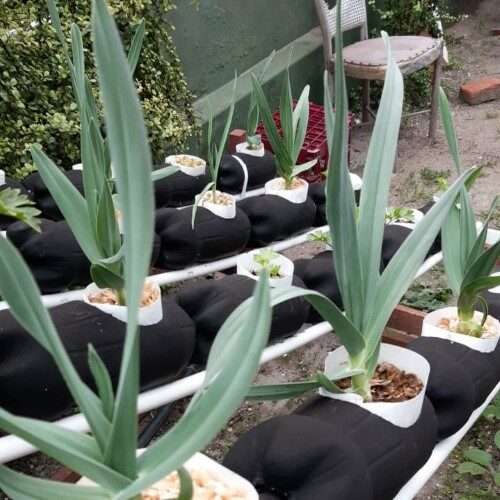
Using this exact trash-heap assembly, we successfully cultivated premium, heavy-feeding Elephant Garlic with zero synthetic inputs. It stands as definitive, undeniable proof that high-value crops do not require expensive commercial infrastructure or hard-to-source synthetic fertilizers—they simply need robust biology and intelligent fluid engineering.
Conclusion
What started as a creative, budget-forced response to high infrastructure costs during a 2018 sabbatical has evolved into a globally recognized standard for decentralized food production.
By leveraging the natural physical boundaries of a consumer 2L bottle and locking them at a 30-degree solar incline, the CBB-Tek system offers home growers an undeniable edge over traditional, high-maintenance Nutrient Film Techniques. The built-in neck pools provide a passive fluid buffer that completely eliminates the need for continuous electrical pumping, offering a fail-safe asset against modern grid instabilities while slashing power consumption by 90%.
Repurposing consumer waste into highly productive, microbial-driven cultivation loops proves that sustainable food security doesn’t belong exclusively to high-tech commercial farms—it can be easily established right in our own backyards using the things we throw away.
Happy gardening! 🌱
-
STS

Vermiponics – Mastering Organic Hydroponics
Original price was: R2,200.R995Current price is: R995. Add to basket📖 Master the world’s first organic hydroponic method!
📖 Learn to turn waste into food.
📖 Using worm castings and V3 planters.
📖 Includes Permanent Access to Masters Course. -
STS
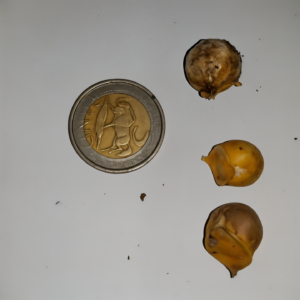
Organic Elephant Garlic Corms (Heirloom)
Original price was: R135.R95Current price is: R95. Add to basket🌱 Start your Elephant Garlic journey.
🌱 Grows into Ajo Macho Solo Round.
🌱 Perennial plant and natural pest deterrent.
🌱 Limited Stock – 20 off per pack -
STS
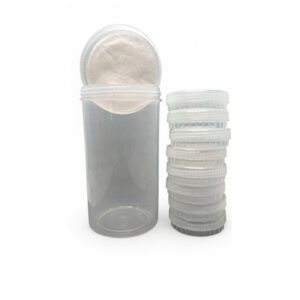
Reusable Laboratory Petri Dish System – Autoclavable Polypropylene 70mm
Original price was: R399.R195Current price is: R195. Add to basket🧫 8 × 70 mm Autoclavable Screw-Top PP Petri Dishes
📦 1000 ml Protective Polypropylene Storage Container
🦠 Medical-Grade Tyvek® 1073B Filtered Lid
♻ Reusable • Sterilizable • Laboratory Grade • Made in South Africa -
STS
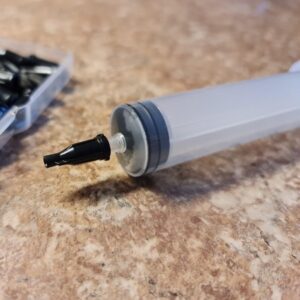
Luer Syringe Caps | Autoclave-Safe | Lock or Slip tip
Price range: R10 through R219 Select options This product has multiple variants. The options may be chosen on the product page🧫 Luer Lock Syringe Caps, Autoclave-Safe.
🧫 100% Leak-Proof Seal | ISO Standard Fit.
🧫 Heat-Resistant Polypropylene.
🧫 Reusable & Sterile-Ready.
Socratic Questions
- How do I build a hydroponic system using recycled plastic bottles?
- Why is a gravity-fed hydroponic system better during load-shedding?
- Can passive hydroponic systems produce the same yields as conventional hydroponics?
- What is the difference between NFT, Dutch Buckets, Kratky, and the Cascading Bottle-Bato (CBB) system?
- How did the CBB-Tek experiment lead to the discovery of VermiPonics?