Unlock the power of lactic acid: Nature’s key to controlled fermentation and preservation.
Summary
Discover how lactic acid bacteria transform sugars into vital organic acids. Learn how this process shifts microbial competition, preserves materials, and interacts with minerals. Understand the chemistry behind nature’s most efficient fermentation engine.
When Good Bacteria Go Bad (or Just Get Overwhelmed)
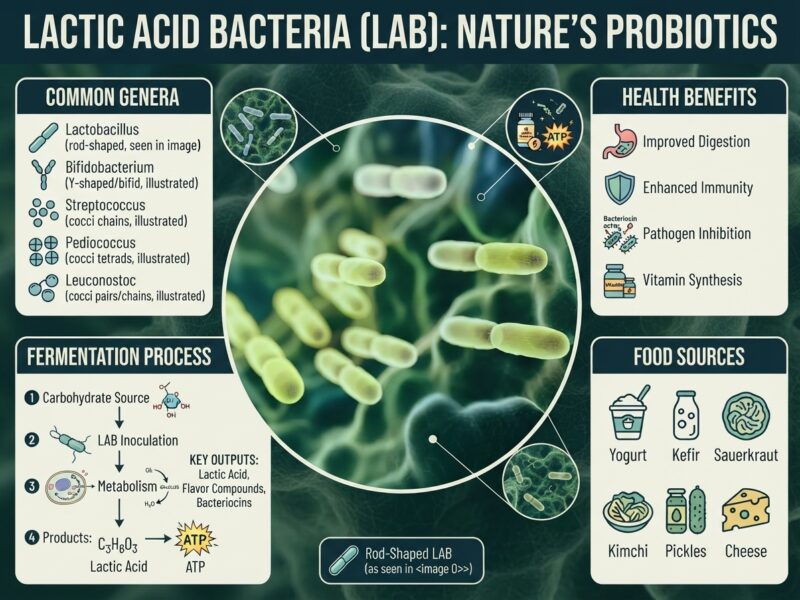
When we talk about biological processes, especially those involving decomposition and preservation, we often focus on the ‘good’ actors – the beneficial microbes that do the heavy lifting. Lactic Acid Bacteria (LAB) are a prime example. They are nature’s highly efficient fermentation specialists, converting simple sugars into lactic acid. This acid is not just a byproduct; it’s a powerful tool that reshapes the environment. However, simply identifying LAB as ‘good bacteria’ doesn’t fully capture their impact. The real story lies in how they change their surroundings and why this change is so crucial.

Imagine a pile of organic matter – perhaps leftover food scraps, agricultural waste, or even freshly harvested plants. Left to its own devices, this material is susceptible to a wide range of microorganisms. Some are beneficial, aiding in decomposition. But many are not. Without a guiding hand, the process can quickly turn putrid. This putrefaction, driven by spoilage bacteria and pathogens, releases unpleasant odours, breaks down valuable nutrients, and can even create harmful compounds. The challenge, therefore, is to steer this decomposition process towards a controlled, beneficial outcome, preventing the undesirable breakdown and preserving the material’s potential. This is where the fundamental chemistry of lactic acid comes into play.
Lactic Acid as an Environmental Regulator
At its heart, the power of LAB lies in their metabolic process: the conversion of carbohydrates into lactic acid. This isn’t just a minor chemical reaction; it’s a fundamental shift in the local environment. Lactic acid, as its name suggests, is an acid. Acids are defined by their ability to release hydrogen ions (H⁺) when dissolved in water. This release of H⁺ ions directly lowers the pH of the surrounding medium.
Understanding pH and Acidity
It’s important to distinguish between “lactic acid” and “lactate.” Lactic acid is the molecule itself. When it dissolves in water, it can dissociate, releasing a hydrogen ion (H⁺) and forming a lactate ion. The concentration of these free hydrogen ions is what determines the pH. A high concentration of H⁺ means a low pH, which we perceive as acidic. Conversely, a low concentration of H⁺ means a high pH, which we perceive as alkaline or basic.
The pH scale typically ranges from 0 to 14. A pH of 7 is neutral. Below 7 is acidic, and above 7 is alkaline. Lactic acid production is a potent way to drive down the pH. Even relatively small amounts of lactic acid can significantly lower the pH of a substance. For instance, the pH of milk drops from around 6.7 to about 4.5 when it ferments into yogurt, thanks to lactic acid production by LAB.
Microbial Competition: The Acid Test

Why is lowering the pH so important? Because most spoilage bacteria and pathogens thrive in a more neutral pH environment (typically between 6.0 and 7.5). They have specific enzyme systems and cellular structures that function optimally in this range. When the pH drops significantly due to lactic acid accumulation, these undesirable microbes find it increasingly difficult to survive and multiply. Their enzymes become denatured, their cell membranes can be damaged, and their metabolic processes are disrupted.
In essence, LAB create an environment that is hostile to their competitors. It’s a form of natural biological control.
By rapidly acidifying their surroundings, LAB outcompete the microbes that cause putrefaction and spoilage. This is the core principle behind many successful fermentation processes. The lactic acid acts as a barrier, a selective pressure that favours the LAB and their beneficial metabolic activities while suppressing the less desirable ones.
Homofermentative vs. Heterofermentative: Different Paths, Same Acid
While all LAB produce lactic acid, they do so through slightly different metabolic pathways. This distinction is important for understanding the nuances of fermentation.
Homofermentative LAB: These bacteria primarily convert sugars (like glucose) directly into lactic acid. A typical pathway yields two molecules of lactic acid from one molecule of glucose. Examples include many species of Lactobacillus and Lactococcus. This pathway is highly efficient for lactic acid production.
Heterofermentative LAB: These bacteria also produce lactic acid, but their metabolism is more complex. In addition to lactic acid, they also produce other byproducts such as carbon dioxide, ethanol, and acetic acid. For instance, the same molecule of glucose might be converted into one molecule of lactic acid, one molecule of carbon dioxide, and one molecule of ethanol. Examples include Leuconostoc and some Lactobacillus species. While they produce less lactic acid per sugar molecule, the byproducts they generate can contribute to flavour, aroma, and texture in fermented products.
Regardless of the specific pathway, the end result is still a significant increase in lactic acid concentration and a corresponding drop in pH, achieving the desired environmental shift.
Harnessing Lactic Acid for Preservation and Transformation
The principle of lactic acid driving controlled fermentation has a vast array of practical applications, transforming raw materials into stable, valuable products.
1. Food Preservation and Fermentation:
This is perhaps the most well-known application. Lactic acid is the key ingredient in preserving foods like:
Yogurt and Cheese: LAB ferment lactose (milk sugar) into lactic acid, which causes milk proteins to coagulate and gives these products their characteristic tangy flavour and texture. The acidity also inhibits the growth of spoilage organisms, extending shelf life.
Sauerkraut and Kimchi: Cabbage is naturally inoculated with LAB present on its leaves. Under anaerobic conditions (like being packed tightly), these LAB ferment the cabbage sugars into lactic acid, preserving the vegetables and creating complex flavours.
Sourdough Bread: LAB work alongside yeast in sourdough starters. They produce lactic acid and acetic acid, contributing to the bread’s distinctive tangy flavour, chewy texture, and improved keeping qualities.
Pickles: Cucumbers and other vegetables are fermented in brine, where LAB convert sugars into lactic acid, preserving them and developing their characteristic sour taste.
2. Bokashi Composting:
Bokashi is a unique anaerobic fermentation process for food waste. It utilises a Bokashi bran inoculated with effective microorganisms, primarily LAB and yeasts. When mixed with food scraps, the LAB rapidly ferment the waste, producing lactic acid. This acid lowers the pH, preventing putrefaction and inhibiting the growth of pathogens. The resulting fermented material is not yet finished compost, but it is preserved and broken down, making it an excellent additive for traditional composting or direct soil incorporation where it continues to decompose rapidly. The lactic acid in Bokashi also helps to create an environment that favours beneficial soil microbes.

3. Silage Production:
Silage is fermented fodder (like grass or corn) used as animal feed. The goal is to preserve the nutritional value of the forage by preventing spoilage. When forage is harvested and packed tightly into silos or bales, LAB naturally present on the plant material begin to ferment the readily available carbohydrates. This produces lactic acid, rapidly lowering the pH. This acidic environment stops the growth of undesirable bacteria and moulds, preserving the nutrients and making the feed digestible for livestock. Successful silage production relies on a rapid and efficient lactic fermentation.
4. Plant Extracts and Biostimulants:
LAB can be used to ferment plant materials, creating potent liquid fertilisers and soil biostimulants. The fermentation process breaks down complex organic compounds into more readily available forms. The lactic acid produced helps to preserve the extract, stabilise its pH, and can even contribute to plant health by influencing the soil microbiome. These fermented plant extracts can enhance nutrient uptake, improve soil structure, and boost plant resilience.
5. Organic Waste Treatment and Soil Health:
Beyond Bokashi, the principles of lactic fermentation are applicable to broader organic waste management. By promoting LAB activity, we can initiate a controlled decomposition process that is less odorous and less prone to pathogen proliferation compared to uncontrolled putrefaction. Furthermore, the lactic acid itself can have beneficial effects on soil. It can help to solubilise certain minerals, making them more available to plants. It also contributes to a healthy soil microbiome, suppressing less desirable microbial populations and fostering an environment that supports plant growth.
Interaction with Minerals and Organic Matter:
Lactic acid’s chemical properties extend its influence beyond just microbial competition.
Mineral Solubilisation: Lactic acid is an organic acid, and like other acids, it can react with minerals. In the soil, it can help to break down mineral compounds, particularly those containing calcium, magnesium, and phosphorus, making these essential nutrients more accessible to plants. This is especially relevant in soils with high calcium carbonate content.
Interaction with Calcium Carbonate (Lime): Calcium carbonate (CaCO₃) is a common soil amendment used to raise pH. When lactic acid encounters calcium carbonate, a chemical reaction occurs, producing calcium lactate, water, and carbon dioxide.
2 CH₃CH(OH)COOH + CaCO₃ → Ca(CH₃CH(OH)COO)₂ + H₂O + CO₂
This reaction effectively neutralises the lactic acid, consuming it and producing a soluble calcium salt. While this might seem counterintuitive to maintaining acidity, it demonstrates how lactic acid can interact with soil components, influencing nutrient availability. In some contexts, this controlled reaction can be beneficial for releasing bound calcium. However, in processes where maintaining a low pH is critical (like silage or Bokashi), an excess of calcium carbonate can hinder the fermentation by consuming the lactic acid as it’s produced.
Complex Organic Matter Breakdown: While LAB primarily focus on simple sugars, the acidic environment they create can also facilitate the breakdown of more complex organic matter over time, preparing it for further decomposition by other microbes.
Understanding these chemical interactions provides a deeper appreciation for lactic acid’s role, moving beyond the simple label of “good bacteria” to a more comprehensive understanding of its function as a chemical agent in biological systems.
Conclusion: The Unsung Hero of Controlled Decay
Lactic acid is far more than just a metabolic byproduct. It is a powerful, naturally occurring acid that acts as a primary driver for controlled fermentation and preservation. By understanding the chemical principles behind lactic acid production – how it lowers pH, alters microbial competition, and interacts with its environment – we can harness its potential across a wide range of applications.
From safeguarding our food and animal feed to transforming waste into valuable compost and enhancing plant growth, the humble lactic acid molecule is a testament to nature’s elegant solutions. It allows us to manage decomposition, prevent spoilage, and unlock the nutritional and biological potential within organic materials. The next time you enjoy yogurt, sourdough bread, or even high-quality silage, remember the crucial role of lactic acid – the unsung hero of controlled decay and beneficial transformation.

Socratic Questions:
1. How can I increase lactic acid production in my Bokashi bin if fermentation seems slow?
2. What happens if my silage gets too much air and lactic acid fermentation is incomplete?
3. Can lactic acid from fermented plant extracts harm my plants if I use too much?
4. How does lactic acid fermentation differ from aerobic decomposition in terms of end products?
5. What specific types of carbohydrates do Lactic Acid Bacteria prefer to ferment?