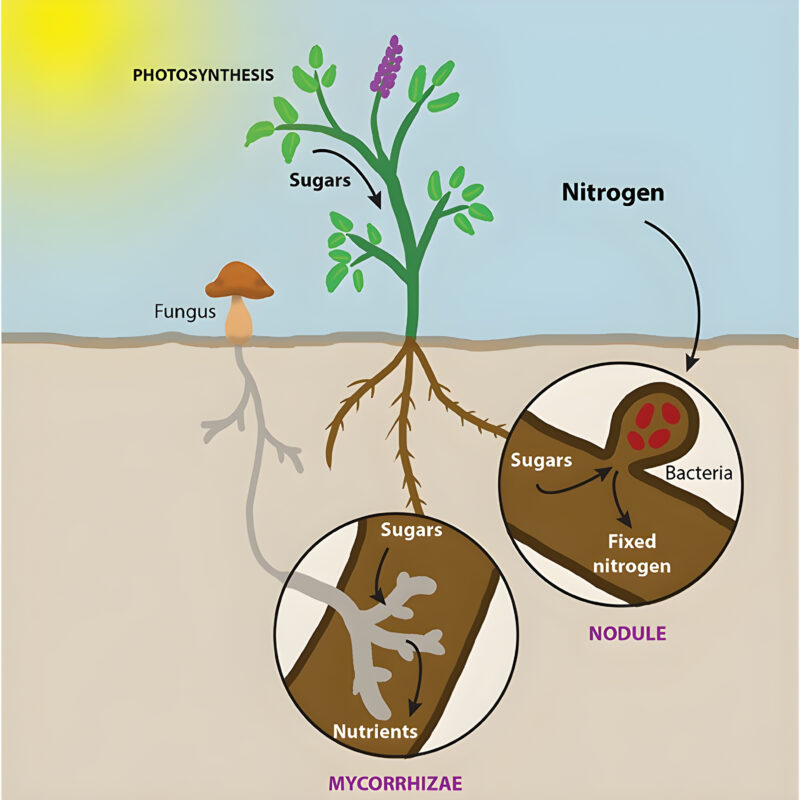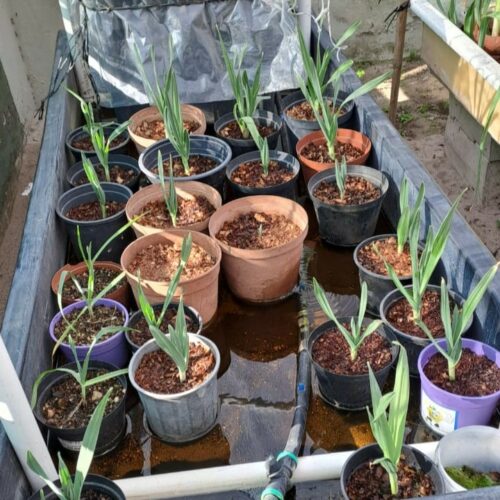
Stop feeding your plants an empty honeycomb!
Summary
Learn why raw biochar is a nutrient thief and how to turn it into a living soil powerhouse. This note breaks down the ancient Terra Preta secrets and reveals our modern, faster methods for creating potent, microbe-rich biochar.
1. The Ancient Secret: What is Terra Preta?
For centuries, the thin, poor soils of the Amazon basin seemed to make continuous farming impossible. Yet, thousands of years ago, indigenous peoples created pockets of what we now call Terra Preta – “black earth” in Portuguese. These soils are still incredibly fertile today, long after the people who made them vanished.
Slash and Burn
The common “slash and burn” farming method in the Amazon only yielded crops for about two years before the nutrients were gone, forcing farmers to leave land fallow for up to 15 years. It wasn’t until around 2007 that science started to unravel the mystery behind this man-made soil.
Terra Preta isn’t natural; it’s an Anthrosol – a human-engineered soil. It was created by mixing charcoal, animal bones, pottery shards, organic matter, and, crucially, material bursting with microbes. These soils remain productive for centuries.
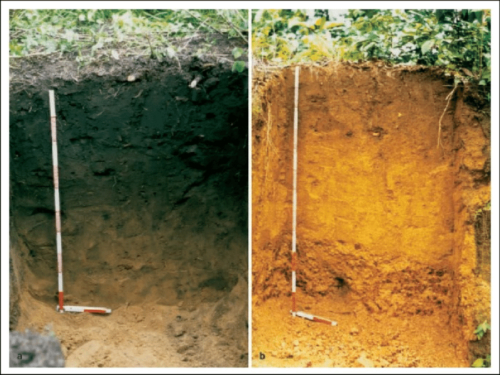
The key ingredient is biochar. However, raw biochar behaves very differently from the charged biochar found in true Terra Preta.
2. The Problem: The “Nutrient Tie-Up” Effect
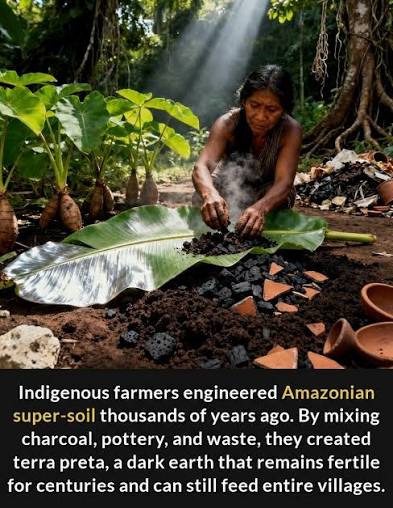
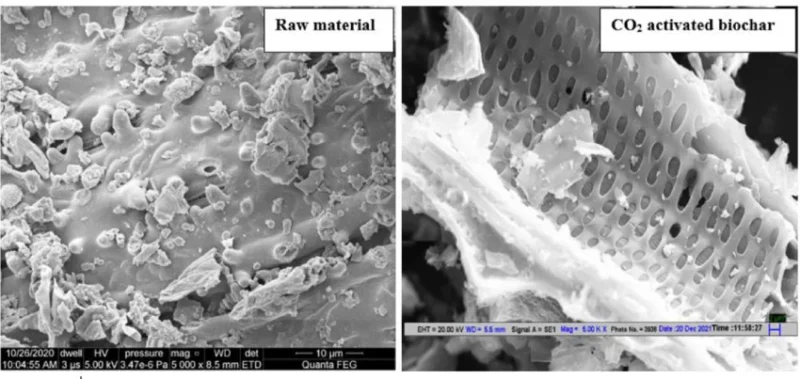
Biochar is essentially charcoal made by heating organic material (biomass) in a low-oxygen environment – a process called pyrolysis. Its main component is carbon, but its real value lies in its incredibly porous structure. A single gram of wood biochar can have a surface area as large as a tennis court!
But here’s the catch: raw, or “virgin,” biochar is like an empty, sterile honeycomb. Its vast surface area is completely unfilled. When you add it directly to your soil, it acts like a vacuum cleaner. Initially, it sucks up available Nitrogen (N), Phosphorus (P), and water to fill its empty pores. This is the “nutrient tie-up” effect, or “nitrogen robbing,” and it can starve your plants for the first growing season.
Biochar Activation: Weathering vs. Charging
This is where the confusion often lies.
Weathering: This is a passive process. It essentially means leaving raw biochar exposed to the elements for an extended period – sometimes over a year. The idea is that rain and natural microbial activity will slowly rinse out some of the ash and potentially begin to colonise the surface. However, it’s uncontrolled, slow, and largely superficial. It doesn’t actively fill the pores with nutrients or introduce a diverse, beneficial microbial community in a targeted way. It’s more about letting nature take its course, slowly.
Charging: This is an active process. We intentionally introduce specific materials to fill biochar’s pores and inoculate it with beneficial life. This is about engineering a living soil amendment from the start. We pre-fill the pores with nutrients and, crucially, inoculate it with a diverse population of beneficial microbes. While any good compost can work, we find vermicompost (worm castings) to be the gold standard. Worm castings are nature’s perfect soil amendment – not only are they nutrient-rich, but they’re packed with beneficial bacteria, fungi, and protozoa that have survived the worm’s digestive tract.
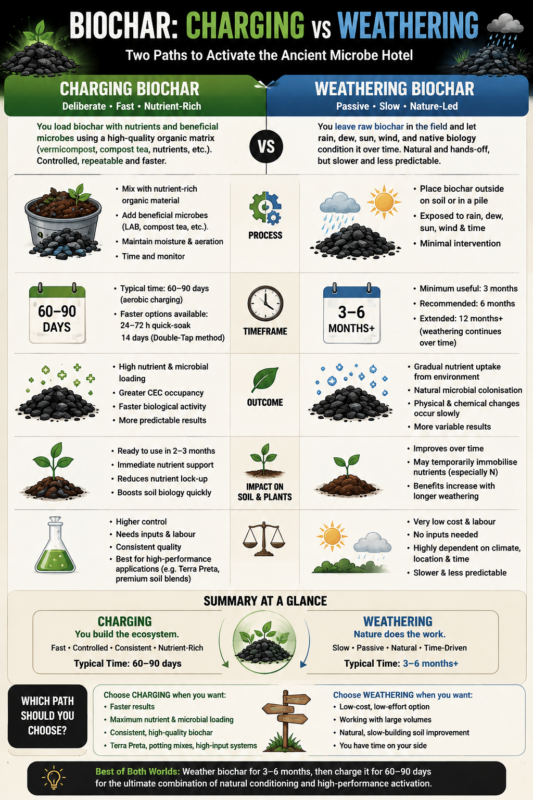
Combining raw biochar with active vermicompost ensures the permanent carbon structure of the biochar is immediately colonised and saturated with a nutrient-rich, living ecosystem. This is what we aim for – not just weathered, but actively charged with the Soil Biome.
3. Method A: The Aerobic “Long-Term” Charge (60–90 Days)
This is the traditional, “professional” approach used in organic agriculture to mimic the formation of Amazonian Terra Preta. It’s a slow but thorough process for charging.
| Step | Action | Technical Rationale |
| 1. Crush & Mix | Grain size 1–5mm. Mix with active Vermicompost (1:9 ratio). | Provides the carbon lattice and the microbial starter (BAM!). |
| 2. Saturate | Non-chlorinated water + 1% sugar/molasses – must be moist, but not soggy. | Dissolves soluble nutrients for adsorption into pores. Feeds the Soil Biome to inoculate the biochar. |
| 3. Aerobic Cure | 60–90 Days. Turn weekly to maintain oxygen. | Microbial colonies slowly colonize the surfaces of the char. |
| 4. Maintenance | Keep moist (sponge-wet) and breathable. | Prevents anaerobic “stalling” and sour smells. |
STS Notes:
- In conventional charging, biochar is typically mixed with normal compost. However, regular compost often has a low biological count. It needs to undergo its own fermentation process before the soil biome can effectively colonise the Terra Preta mix.
- While some sources suggest a 1:1 mixing ratio of biochar to compost, this is generally incorrect. We recommend applying only about 10% biochar to the volume of compost.
- Higher ratios may cause the charging process to stall, as the charcoal can rob the compost of nutrients due to its high Cation Exchange Capacity (CEC) if not balanced correctly.
4. Method B: The “Quick-Soak” (Worm Tea Inoculation)
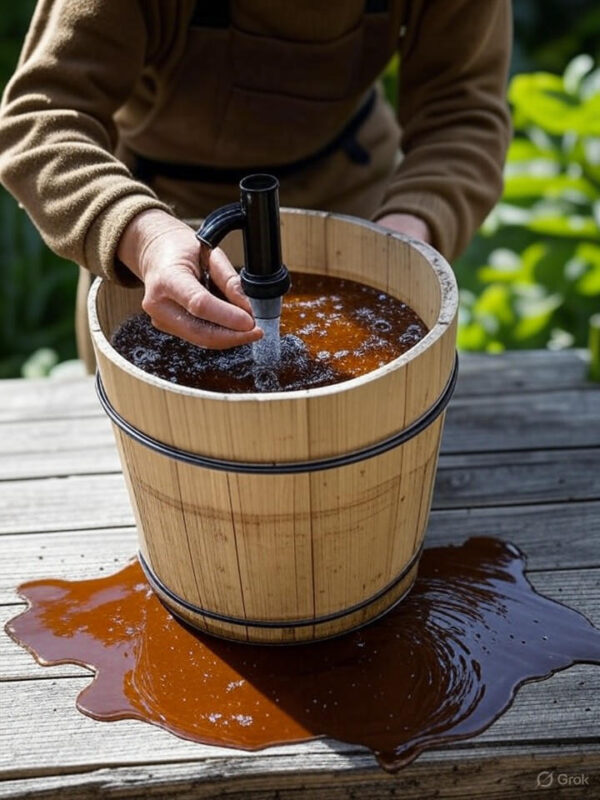
If time is short, the liquid carrier method can flush microbes into the char’s macro-pores. The quickest way to introduce a high population of efficient microbes (BAM!) into your soil is using Actively Aerated Worm Tea (AAWT) for 24-72 hours.
However, this rapid liquid method has a major drawback: it generally doesn’t foster the full, balanced range of microbes, especially fungal life. This method uses the liquid to instantly flush microbes into the surface pores of the biochar. But with biochar’s massive surface area, this quick flush is largely superficial. For a truly robust, integrated, and long-lasting biome – one that includes essential bio-protectants like beneficial Trichoderma and nutrient-scavenging Mycorrhizal Fungi – the longer, more stable solid-state fermentation (curing with vermicompost) is strongly advised.
5. The “Living Soil” Warning
As you can see, activating biochar effectively takes time, the right materials, and aeration. Conventionally charged biochar is an aerobic living ecosystem. Because these methods rely on aerobic microbes, the product must remain breathable. Store it in vented containers or cloth bags. Keep it moist but not waterlogged. Sealed plastic bags often lead to microbial die-off and bad smells – a major red flag when buying commercial charged biochar.
6. Terra Preta Nova — Engineered Biochar Activation
Traditional Terra Preta demonstrates what happens when biochar, organic matter and microbial life are allowed to develop together over time. Charging accelerates that process by deliberately loading the biochar with nutrients and biology. Terra Preta Nova (TPN) takes the principle one step further: instead of simply charging finished biochar, we pre-ferment the entire organic matrix around it.
TPN is built from biochar, compost or suitable agricultural waste, and BAM! vermicompost inoculant. The mixture is prepared as a Bokashi-style solid fermentation and allowed to pre-ferment for approximately 14 days. During this stage, the organic material is preserved and transformed while the biochar becomes intimately associated with the fermenting biological matrix.
The resulting TPN can then be stored until required. Before application, we use our Double-Tap activation: the fermented material is conditioned with calcium carbonate and allowed to aerate. This shifts the material back toward aerobic conditions, allowing the aerobic microbial community to rapidly establish throughout the TPN.
The result is not simply biochar that has been charged. It is a pre-conditioned, biologically active soil matrix in which the carbon, organic matter, nutrients and microbial community have already been brought together.
That is the principle behind Eco BiniTM Terra Preta Nova:
Don’t wait for Terra Preta to happen in the soil. Build the biological system first — then put it in the soil.
In practical terms, weathering lets nature condition the carbon, charging deliberately loads it, while TPN pre-builds the entire carbon–organic–microbial system before application.
References
-
STS
LAB-X: Concentrated Lactic Acid Bacteria Starter (500ml Bettix)
Original price was: R360.R249Current price is: R249. Add to basket🧫 Food-grade fermentation starter culture
🧫 Whey-purified from GRAS Efficient Microbes
🧫 Broad LAB consortium for diverse fermentation
🧫 CalMag ionic-lock stabilized -
STS
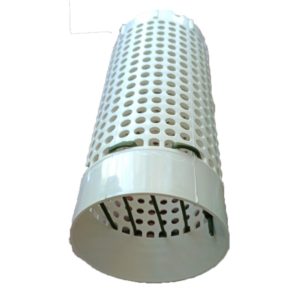
Pico-Flow CFT | In-Ground Vermicomposter & Worm Magnet
Original price was: R1,199.R849Current price is: R849. Add to basket🛠 In-Ground Continuous Flow-Through Design Worm Bin
🛠 PicoFlow CFT: Waste Processor & Worm Magnet.
🛠 UV Resistant | 2500ml Capacity | Screw Cap.
🛠 Including the Vermicompost CFT Manual -
STS
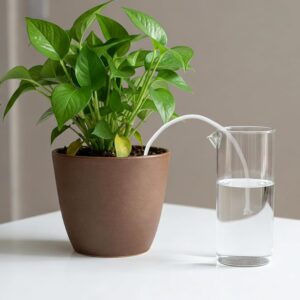
Self-Irrigating Capillary Wicking Cord – 10 meter
Original price was: R140.R115Current price is: R115. Add to basket🌱 High-performance 4mm capillary cord.
🌱 Consistent, self-watering moisture delivery.
🌱 Wicking water in self-watering planters, hydroponic seedlings
🌱 Automation-free vacation watering. -
STS
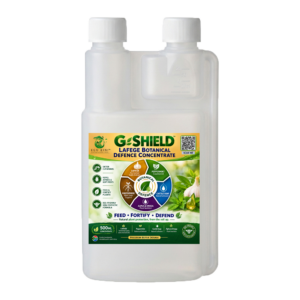
G-Shield — Cutworm, Aphid & Seedling Root Armor (500 mL)
Original price was: R280.R195Current price is: R195. Add to basket🧄 LAB-fermented garlic with SAC enrichment
🌿 Garlic & peppermint botanical defense
🛡 Soil-zone and foliar pest deterrent
🌱 Root-zone support for young plants
Socratic Questions
- What’s the practical difference in soil performance between “weathered” biochar and “charged” biochar?
- If I leave raw biochar out in the rain for a few months, is it safe to use?
- Can I speed up the “charging” process by using more worm castings?
- What are the key indicators of a “bad smell” in charged biochar, and what does it mean?
- How does the anaerobic Lactic Acid Fermentation in the “Double-Tap” protocol help clean out the biochar pores?