
Cellulose stocks and organic textiles are highly hygroscopic materials that warp, crack, and generate dangerous electrostatic charges when exposed to dry air. This industrial engineering guide explores how maintaining strict Equilibrium Moisture Content (EMC) via non-condensing ultrasonic dry fog eliminates print misregistration, paper jams, and fiber fractures. Learn the precise relative humidity setpoints required to stabilize high-speed production lines, suppress combustible airborne lint, and ground static hazards safely without surface wetting.
Summary
Introduction
When industrial facility managers consider environmental automation, the mind frequently drifts to niche agricultural operations like mushroom cultivation or controlled climate greenhouses. However, ultrasonic humidification plays an equally transformative role on the heavy manufacturing floor.
From commercial printing lines and textile spinning mills to high-precision electronic and pharmaceutical cleanrooms, managing atmospheric water vapor is a critical parameter for maintaining raw material integrity and high machine throughput. Let’s analyse these micro-climates through an engineering lens to stabilize production lines and secure product consistency.
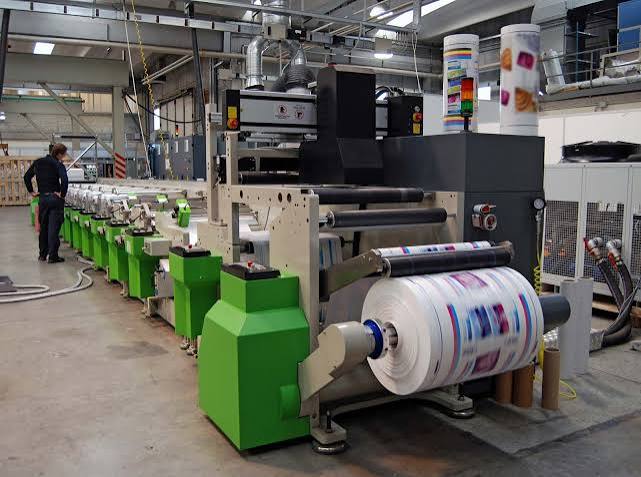
In high-speed manufacturing, plant managers routinely optimize mechanical parameters and motor frequencies while ignoring a silent thermodynamic variable: the atmospheric moisture balance of the factory floor. Cellulose-based paper stocks and natural organic fibers are highly hygroscopic materials—they act like dimensional sponges, rapidly exchanging moisture with the surrounding ambient air to maintain hydrostatic equilibrium. Allowing indoor relative humidity to drift out of specification causes severe material structural failures, high-voltage static accumulation, and expensive machine downtime. This lab note outlines the engineering principles of managing Equilibrium Moisture Content (EMC) and details how non-condensing ultrasonic dry fog stabilizes high-speed printing presses and textile weaving loops.
The Core Problem: Equilibrium Moisture Content & Dimensional Instability
Both paper and textiles possess an inherent physical property known as Equilibrium Moisture Content ( EMC )—the specific internal moisture level where the material neither gains nor loses water weight to the surrounding air.
When a factory’s relative humidity drops below a critical baseline, the dry air aggressively strips bound moisture straight out of the raw material matrix.
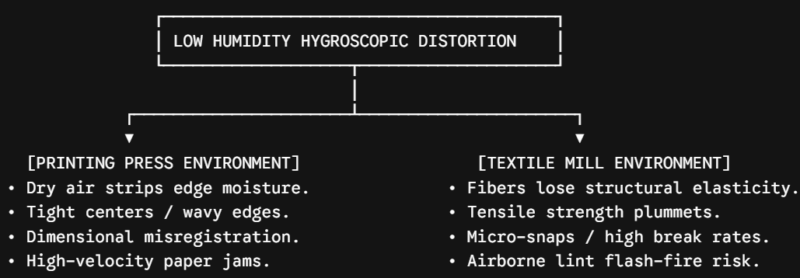
1. In the Printing and Packaging Plant
Cellulose fibers expand lengthwise when exposed to moisture and contract sharply when dry. In a low-humidity press room (less than 40% RH), a stack of paper sheets or a large web-fed roll loses moisture rapidly from its exposed outer edges while the dense core remains insulated and damp. This uneven gradient creates severe structural warping:
- Tight Centers and Wavy Edges: The perimeter of the paper sheet shrinks while the center retains its original dimension, causing the paper to warp, bubble, and ripple.
- Dimensional Misregistration: In multi-color offset or high-speed digital printing, paper passes sequentially through successive cylinders to overlay distinct ink layers (Cyan, Magenta, Yellow, and Key/Black). If the sheet contracts by even a fraction of a millimeter between ink stations due to dry air exposure, the colors fail to align perfectly, rendering the final print blurry, out of focus, and unmarketable.
- Porosity and Absorbency Anomalies: Atmospheric moisture alters both the paper’s surface porosity and the ink’s operational viscosity. Excess moisture causes individual paper fibers to swell, leading to ink bleeding and muddy color profiles. Conversely, overly dry conditions cause the paper fibers to repel water-borne inks, which increases drying times and causes severe tracking or smudging off the rollers.
- Feeding Jams: Warped, statically charged paper stocks curl at the feeder guides and suction heads. This triggers immediate machine sensor trips, high-speed press jams, and extensive mechanical downtime.
2. In the Textile Spinning and Weaving Mill
Natural yarns like cotton, wool, and linen rely directly on internal bound moisture to maintain their structural elasticity and raw tensile strength.
- Brittle Fractures: When ambient relative humidity plummets, yarns lose their structural flexibility and become highly brittle. Under the intense tensile strain of modern high-speed looms, these dry threads snap continuously. Each micro-snap trips a mechanical brake, forcing a complete operational halt until an technician manually knots and re-threads the machinery.
- Weight Loss Deficits: Raw textiles are traded internationally by weight. If a mill processes yarn in an arid environment, the finished product loses up to 4% to 5% of its total mass purely to airborne evaporation—directly eroding bottom-line margins before the stock ever ships.
- Dust and Lint Suppression: Mechanical textile manipulation generates massive quantities of airborne organic dust and micro-lint. High-output ultrasonic humidification introduces targeted moisture that collides with and binds to these suspended particulates, weighting them down and pulling them out of the breathing zone and away from sensitive mechanical gears.
The Secondary Threat: Electrostatic Accumulation and Fire Risks
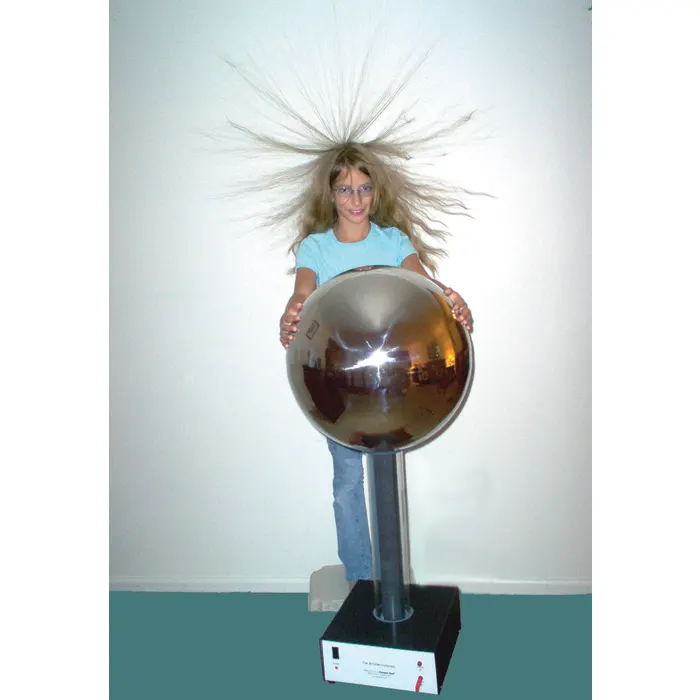
Beyond structural material warping, low relative humidity creates an invisible, highly dangerous physical phenomenon: massive electrostatic generation.
When dry insulating materials (like paper webs, plastic packaging films, or organic synthetic yarns) slide over metal rollers and guiding plates at ultra-high velocities, continuous friction strips electrons from the surface materials.
Frictional Motion + Dry Insulating Material High-Voltage Static Accumulation
If the ambient air is kept humid (above 50% RH), a microscopic, non-condensing layer of moisture forms naturally on all surfaces. Water molecules contain highly mobile polar ions that render the air naturally conductive. This conductive boundary layer acts as a permanent, invisible ground wire, safely dissipating static charges back into the building’s grounding loop before they can accumulate.
However, in dry air (less than 35% RH), this grounding dissipation pathway completely disappears. Static charges build up continuously on the machinery and material lines, leading to severe operational hazards:
- Material Clinging: Sheets of paper fuse together via electrostatic attraction, causing double-sheet feeds that can physically dent print heads.
- Personnel Shocks: Operators face constant high-voltage electrostatic shocks upon touching machinery frames, creating an unstable and unsafe working environment.
- Dust and Lint Flash Fires: Because textile mills are filled with highly combustible airborne organic lint, a single static discharge spark can instantly ignite the suspended particulate cloud, triggering a catastrophic flash fire across the factory floor.
Dust and lint Suppression
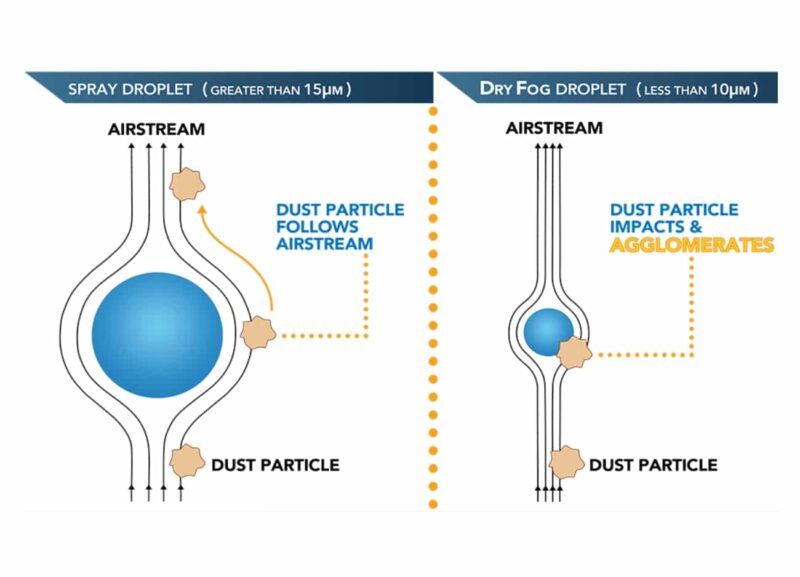
In physics, if a water droplet is too large (like a 50-micron spray), a tiny dust particle or textile lint strand gets pushed away by the slipstream (the cushion of air moving around the falling droplet) and never touches it. But when the water droplet is matched in size to the dust particle (1 to 10 microns, like ultrasonic dry fog), they collide, the water wets the particle, it becomes heavy, and it drops out of the air.
The Engineering Solution: Non-Condensing Ultrasonic “Dry Fog”
To stabilize materials and ground static without damaging nearby digital electronics or wetting heavy machinery components, industrial environments require a specific type of humidification: Non-Condensing Dry Fog.
Standard high-pressure water misters or mechanical impeller systems throw large, heavy water droplets ranging from 50 to over 100 microns in diameter. These droplets lack the surface-area-to-mass ratio to evaporate quickly; they fall out of suspension, pooling on metal machinery surfaces, rusting gears, and directly soaking paper stocks or fabric looms.
Industrial ultrasonic arrays utilize high-frequency piezoceramic transducers vibrating at 1.6 to 2.4 MHz to break liquid water into a cool, micro-fine mist with a uniform droplet size of less than 5 to 10 microns. Because these droplets are so small, their surface area is massive relative to their volume. The surrounding ambient air instantly absorbs them via flash-evaporation before they can make physical contact with floors, electronics, or material lines.
Strategic Environmental Setpoints for Manufacturing
To maximize production efficiency, industrial facilities should integrate an automated ultrasonic control loop locked to these exact target windows:
- Commercial Printing & Binderies: Maintain a stable 50% to 55% RH window. This zone keeps paper flat and completely grounds static electricity without softening water-based adhesives.
- Textile Carding & Spinning: Maintain a targeted 60% to 65% RH window. This higher saturation level maximizes yarn fiber elasticity and eliminates micro-snaps on high-speed spinning frames.
- Weaving & Loom Floors: Maintain a locked 70% to 75% RH window to ensure warp threads can handle the aggressive, rhythmic friction of modern mechanical shuttles.
More Than Mushrooms: Broad B2B Applications
While ultrasonic humidifiers are famed in specialty mushroom cultivation—where precise humidity is mandatory for heavy pinning—their industrial deployment spans multiple high-value B2B sectors:
- Electronics & SMT Assembly: Eliminating Electrostatic Discharge (ESD) hazards around sensitive microchips and printed circuit board components.
- Pharmaceutical Packaging: Ensuring stable relative humidity environments during tablet pressing and blister packaging to prevent moisture-sensitive chemical degradation.
- Art Galleries and Museums: Protecting historical timber, canvas, and organic artifacts from hygroscopic cracking caused by sudden climate shifts.
- Data Centers & Server Rooms: Preventing high-voltage static build-ups that can scramble magnetic storage media and trigger server failures.
Why Choose Ultrasonic Infrastructure Over Thermal Steam?
- Thermal Efficiency: Ultrasonic units operate with roughly 90% less electricity than traditional electrode or immersion steam humidifiers, as they do not need to boil water to create a gas phase.
- Adiabatic Cooling Effect: Because ultrasonic mist absorbs heat energy from the surrounding air during flash-evaporation, it provides a natural cooling effect that lowers the mechanical air conditioning load on the factory floor.
- Instantaneous Response: Ultrasonic transducers fire and shut down instantly, allowing smart digital controllers (like the SHT35 sensor arrays) to maintain tight, precise humidity bands without lagging or overshoot.

By replacing primitive high-pressure spray lines with a smart, sensor-driven ultrasonic manifold, industrial facilities can securely stabilize material dimensions, eliminate static hazards, and keep high-speed production lines running smoothly 24/7.
-
STS

750ml Full-Bore Polypropylene Bottle | Cordycep...
Original price was: R89.R59Current price is: R59. Add to basket🧫 750ml autoclavable Polypropylene bottle with screw-cap
🧫 Straight-sided full-bore 100mm for… -
STS
Oyster Grow Cap and Lock Ring [40mm]
Original price was: R32.R29Current price is: R29. Add to basket🏗 Easy filtered sealing of Grow Bags
🏗 40mm autoclavable caps with lock rings.
🏗 Full-bore rep… -
STS
Reusable Laboratory Petri Dish System – A...
Original price was: R399.R195Current price is: R195. Add to basket🧫 8 × 70 mm Autoclavable Screw-Top PP Petri Dishes
📦 1000 ml Protective Polypropylene Storage… -
STS

Pink Oyster Mushroom for Vibrant Harvests
Original price was: R1,999.R995Current price is: R995. Select options This product has multiple variants. The options may be chosen on the product page🧪 Pleurotus incarnatus – Pink Oyster strain.
🧪 Rapid colonization – salmon-pink clusters.
🧪…