Every technology begins with a worldview. Before Bundu Teq became a collection of systems, products and laboratory methods, it began with a simple observation:
Nature already knows how to build fertile soils, recycle nutrients, purify water, grow food and regulate disease.
Rather than replacing those ecological processes with industrial chemistry, Bundu Teq studies how they work and engineers environments where they can function again. This Declaration defines the principles that guide every Bundu Teq system, product and STS Lab Note.
Summary
Restoring Nature’s Refinery
For thousands of years humanity learned by observing nature.
- Forests built fertile soil without fertilizers.
- Wetlands purified water without treatment plants.
- Microbes recycled nutrients without factories.
- Fungi transformed dead carbon into new life.
- Earthworms cultivated living soils long before agriculture existed.
Nature had already solved the problems we now attempt to solve with industrial chemistry.
Yet during the Industrial and Green Revolutions we gradually replaced biological processes with manufactured inputs.
- Synthetic fertilizers replaced living soils.
- Chemical pesticides replaced ecological balance.
- Sterilization replaced healthy microbial communities.
- Imported chemical inputs replaced local biological cycles.
We became increasingly dependent on industries attempting to manufacture what nature has always produced freely.
Nature’s Refinery

Bundu Teq begins with a different assumption.
Nature is not something to overcome.
Nature is the most sophisticated biological production system ever developed.
Every healthy ecosystem functions as a living refinery, continuously converting sunlight, water, air, minerals and biological waste into fertile soil, healthy plants, biodiversity and resilient life.
We call this Nature’s Refinery.
Rather than replacing biology with chemistry, Bundu Teq studies the ecological processes that originally performed each function and engineers environments where those processes can function once again. Every challenge begins with one defining question:
What ecological process originally performed this function?
Every Bundu Teq solution begins there.
The objective is never to replace nature.
The objective is to understand it well enough to work with it.
Engineering Biological Independence
Engineering Biological Independence does not reject technology.
It uses engineering to restore biology instead of replacing it.
Technology becomes a tool that enables living systems to function as they were designed.
Our role is no longer to dominate nature.
Our role is to become custodians of the land.
The Bundu Teq Framework is guided by four biological engineering principles.

The Four Rs
- Reduce industrial dependence.
- Reuse nature’s biological processes.
- Recycle biological resources.
- Refine our knowledge to restore Nature’s Refinery.
These Four Rs are not marketing slogans.
They are engineering principles for restoring resilient biological production systems.
The Three Paradigm Shifts
Bundu Teq is built upon three paradigm shifts that fundamentally change how biological systems are understood.
1. Plant-Available Nutrients(Microbial Unlocking)
Old Thinking
Plants feed on compost.
Paradigm Shift
Plants cannot absorb insoluble organic matter.
The soil biome first mineralizes organic resources into water-soluble nutrients that plants can absorb.
- Nutrients already exist within biological resources.
- Our task is not to manufacture them.
- Our task is to unlock them.
2. Pasteurizing Bio-Engineers (Worm-Gut Pasteurization)
Old Thinking
Earthworms consume organic waste.
Paradigm Shift
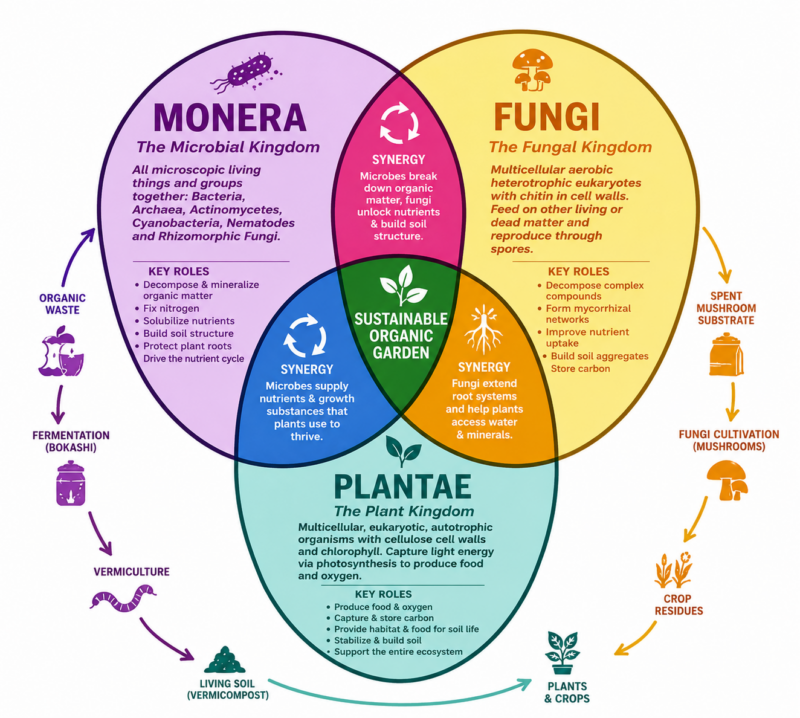
Earthworms graze microbial biomass. As that biomass passes through the worm gut it becomes biologically stabilized into vermicast rich in Beneficial Active Microbes (BAM!), enzymes, plant growth regulators and plant-available nutrients.
The worm is not a waste recycler.
It is nature’s biological pasteurizer—and bio-engineer.
3. Selective Nutrition
Old Thinking
Contamination is a sterility problem.
Paradigm Shift
Contamination is a nutrition problem.
By biologically pre-digesting substrates through Monera systems, simple nutrients are consumed first, leaving predominantly lignocellulosic carbon together with mineralized nutrients. These remaining carbon structures require the higher-order extracellular enzymes produced by fungi, allowing gourmet mycelium to flourish while many competitors remain nutritionally excluded.
Selective Nutrition replaces total sterilization.
Together these three paradigm shifts transform waste into resources and biology into infrastructure.
Stewardship
Genesis 2:15 reminds us:
“The Lord God took the man and put him in the Garden of Eden to work it and take care of it.”
Bundu Teq sees stewardship as neither domination over nature nor withdrawal from it.
It is responsible biological engineering.
- To understand.
- To restore.
- To refine and improve our knowledge and stewardship.
- To leave every biological system stronger than we found it.
Our Vision
The future will not be built by manufacturing more biology.
It will be built by understanding it.
By restoring local ecological processes, communities can once again produce fertile soil, healthy food, clean water, thriving biodiversity and resilient biological production systems using the resources already around them.
That is Engineering Biological Independence.
That is Bundu Teq.
From Philosophy to Practice
The Eco Bini™ Ecosystem
Biological independence does not mean isolation. It means building systems that become progressively more self-supporting by working with natural biological processes instead of constantly fighting against them. Rather than existing as a single product or technology, Bundu Teq is implemented through an integrated biological engineering ecosystem.
Eco Bini (Pty) Ltd
Eco Bini is the research and technology company responsible for developing new biological systems, methodologies and products. It is here that ideas are conceived, prototypes are developed and new engineering approaches are explored.
Sustainability Testing Station (STS)
The Sustainability Testing Station is our research and validation facility. Every concept is challenged through practical experimentation under real South African conditions. Failures are analyzed, successful approaches are refined and repeatable methods are documented as STS protocols and Lab Notes.
Our philosophy is simple:
The best engineering begins with failure.
- Ideas are inexpensive.
- Reliable systems are earned through testing.
SouthPoint eSolutions (SPeS)
SouthPoint eSolutions (SPeS) is the commercial platform through which validated Eco Bini technologies become available to growers, researchers and enthusiasts. Not every product sold through SPeS is developed by Eco Bini™.
However, products carrying the STS Approved designation have been practically evaluated through the Sustainability Testing Station before receiving our recommendation.
Together these three components form a continuous cycle of innovation:
Eco Bini™ develops.
STS validates.
SPeS delivers.
Engineering Biological Independence.
-
STS

STS 9kg/h Commercial Ultrasonic Humidifier
Original price was: R29,999.R26,595Current price is: R26,595. Add to basket🏗 9kg/h ultrasonic humidification with smart control.
🏗 High-Volume 220 m3/h Air Circulation
🏗 Dual Supply (Bottle/Tap),
🏗 Unmatched Electrical Efficiency – 360W power -
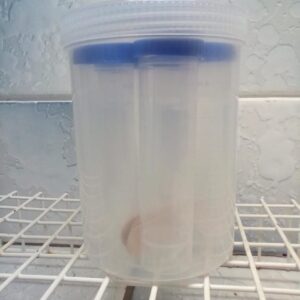
5× Genetics Slant Kit | Freestanding 50 ml PP Vials
R249 Add to basket🧫 5 × 50 ml Freestanding PP Screw-Cap Vials
🛡️ Protective Full-Bore Polypropylene Storage Tub
🧬 Professional Mycelium Preservation System -
STS
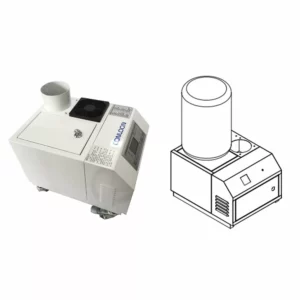
STS 7kg/h Commercial Ultrasonic Humidifier
Original price was: R28,500.R24,999Current price is: R24,999. Add to basket🏗 Commercial 7 kg/h ultrasonic humidifier.
🏗 Dual water supply (autofill or 20L bottle interface).
🏗 Gen³ heads, stainless steel, auto shut-off.
🏗 Smart Humidity control – CE Accredited. -
STS

Eco Bini™ BioaKt Media/Substrate Conditioner | 2000 ml
Original price was: R195.R149Current price is: R149. Add to basket🏗 Bundu-Tek additive with kelp alginates – No autoclave needed.
🏗 Alkaline pH Pasteurizer
🏗 Self-sterilizing formula
🏗Boost yields and colonizing times
The Microbial Bridge
Bio-Available Feeding
Mycelial Dominance
SouthPoint eSolutions Manifesto
We have gone and put pen to paper – check out the shop, or read our manifesto
Socratic Questions:
- How can I replace commercial fertilizers with upcycled farm waste?
- How does a small farmer transition from conventional to regenerative agriculture?
- What are the best methods for maintaining permanent soil cover?
- Can regenerative practices really replace chemical pesticides?
- How does a small farmer verify their carbon sequestration?