Inhibit fungal spore germination and wild yeast activity using lactic acid activated potassium sorbate.
Summary
Potassium sorbate is primarily fungistatic: it inhibits or delays fungal spore germination and subsequent growth rather than functioning as a rapid fungicidal agent. Combining organic lactic acid with potassium sorbate creates the low-pH environment required to generate un-dissociated sorbic acid. Thermal inactivation of carrier microbes prevents enzymatic degradation and stabilizes the synergistic antimicrobial system.
The Limitations of Sorbate in Biological Systems
Preventing fungal contamination in stored biological ferments, organic liquid inputs, and post-harvest produce is a fundamental challenge in ecological agriculture. Potassium sorbate (C6H7KO2) is widely recognized as a safe, non-toxic organic salt capable of inhibiting fungal proliferation. However, practical attempts to use potassium sorbate often fail due to two primary misunderstandings: a confusion between fungicidal and fungistatic modes of action, and a failure to manage solution pH.
A critical physiological distinction exists between killing active fungal growth and preventing spore germination:
- Fungicidal Agents (e.g., peracetic acid, hydrogen peroxide, high heat) violently rupture cell membranes or oxidize cellular structures, actively destroying established vegetative mycelium and live fungal colonies.
- Fungistatic Agents (e.g., potassium sorbate, weak organic acids) do not kill established vegetative hyphae or mature fungal mats. Instead, they disrupt metabolic energy pathways required for spore germination, germ tube elongation, and cellular division.
When applied to an active, dense fungal infection with established vegetative mycelium, potassium sorbate is virtually ineffective. The mature fungal biomass possesses sufficient metabolic momentum and antioxidant defenses to bypass the inhibition mechanism. Furthermore, when raw potassium sorbate is introduced to unsterilized biological liquids containing live Lactic Acid Bacteria (LAB), specific bacterial enzymes can metabolize the sorbate molecule into 2,4-hexadien-1-ol. This metabolic pathway produces a distinct, unwanted geranium-like odor while completely destroying the preservative capacity of the solution.
Acid-Base Equilibrium and the pKa Threshold
Dry Potassium sorbate salt itself possesses low inherent antifungal activity. When dissolved in pure water, it dissociates into potassium ions (K+) and sorbate anions (C6H7O2–). Because the sorbate anion carries a negative charge, it is lipophobic and cannot cross the hydrophobic lipid bilayer of fungal spore membranes.
To become biologically active, the sorbate anion must bind with a free hydrogen ion (H+) to form un-dissociated sorbic acid (C6H8O2). Only this un-charged, lipophilic form can freely diffuse across cellular membranes.
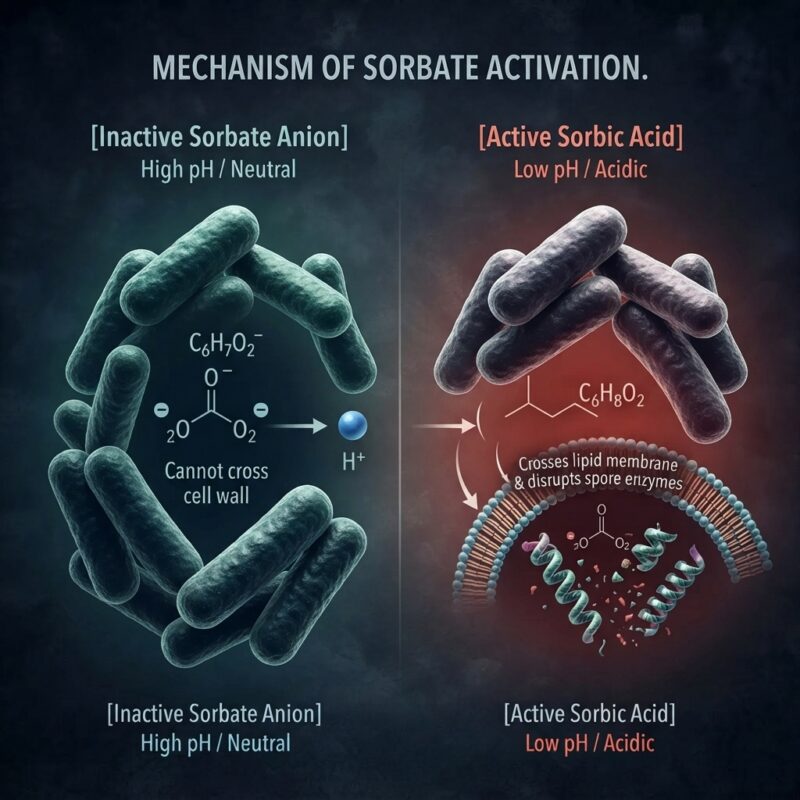
The conversion rate is governed entirely by the acid dissociation constant (pKa) of sorbic acid, which sits at 4.76. The mathematical equilibrium ratio between inactive sorbate ions and active sorbic acid is dictated by solution pH:- At pH 6.0, less than 5% of the compound exists as active sorbic acid.
- At pH 4.76, exactly 50% exists as active sorbic acid.
- At pH 3.5–3.8 (easily achieved via Lactic Acid addition), 90% to 95% of the compound is converted into un-dissociated sorbic acid.
By introducing Lactic Acid (C3H6O3) as the acidifying agent, the system provides a dense concentration of free hydrogen ions. This drives the equilibrium reaction hard to the right, converting almost the entire sorbate mass into active, lipophilic sorbic acid.
Intracellular Mode of Action on Fungal Spores
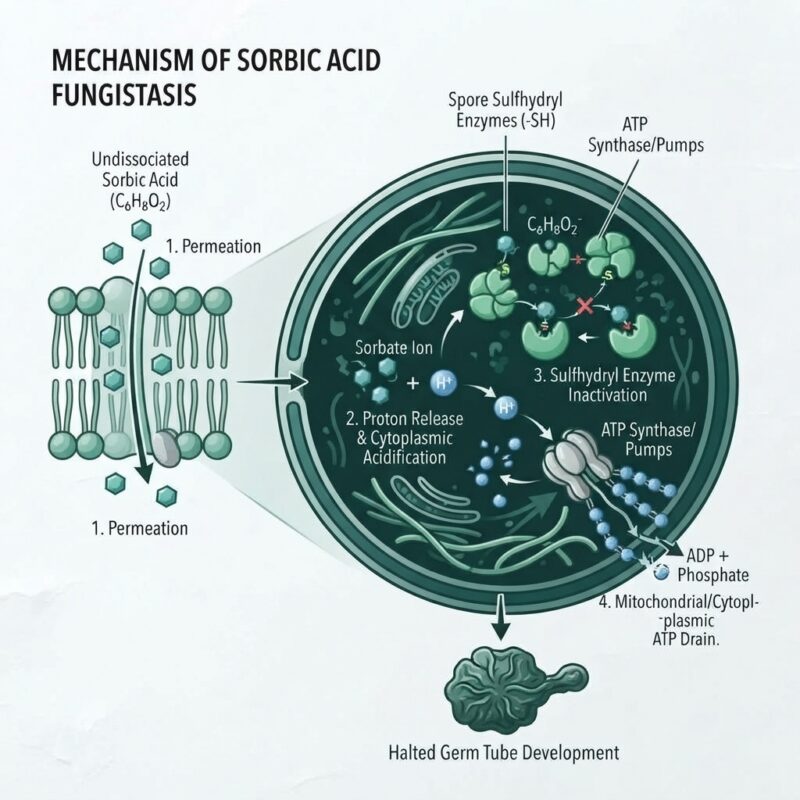
Once un-dissociated sorbic acid is established in an acidic liquid medium, its fungistatic action targets the earliest stages of the fungal life cycle—specifically dormant spores, asexual conidia, and single-celled yeasts.
Basically in an acidified media the sorbic acid can travel through the lipid [fatty] cell membrane inside cell, which is not acidic, and the internal cell mechanism tries to neutralize the acid to retain a neutral cell internal pH.
1. Trans-Membrane Diffusion
The un-charged sorbic acid molecule diffuses across the fungal spore membrane. Because the extracellular environment is acidic (pH 3.5–4.0), the sorbic acid remains un-dissociated outside the cell.
2. Intracellular Dissociation
Upon entering the fungal spore cytoplasm—where the internal environment is maintained at a neutral pH of approximately 7.0—the sorbic acid instantly dissociates back into sorbate anions and free protons (H+). This releases a flood of hydrogen ions inside the spore, rapidly dropping the internal cytoplasmic pH.
3. Enzyme Inactivation & ATP Depletion
The sudden internal acidification causes severe metabolic disruption:
- Sulfhydryl Binding: The sorbate anion binds covalently to sulfhydryl (-SH) groups on critical respiratory enzymes, including alpha-ketoglutarate dehydrogenase and catalase, shutting down early spore metabolism.
- Proton Pump Exhaustion: To prevent lethal internal acidification, the spore is forced to activate membrane-bound H+-ATPase proton pumps to flush excess protons back out of the cell.
- Germination Halt: This continuous proton pumping consumes the spore’s limited stored ATP energy reserves. Starved of energy, the spore is rendered incapable of swelling, synthesizing a germ tube, or initiating vegetative hyphal growth.
Thermal Stabilization of the Carrier System
While lactic acid provides the necessary hydrogen ions for chemical activation, pairing sorbate with organic Lactic Acid Bacteria (LAB) liquids requires precise physical stabilization. Live Lactobacillus species express enzymes capable of metabolizing sorbic acid over time, producing unsaturated hydrocarbon byproducts (such as 2,4-hexadien-1-ol) that ruin liquid preparations.
To construct a stable carrier matrix, the mixture of filtered LAB liquid, additional lactic acid, and potassium sorbate must undergo high-temperature thermal processing. In FungiStop we autoclave at 121C.
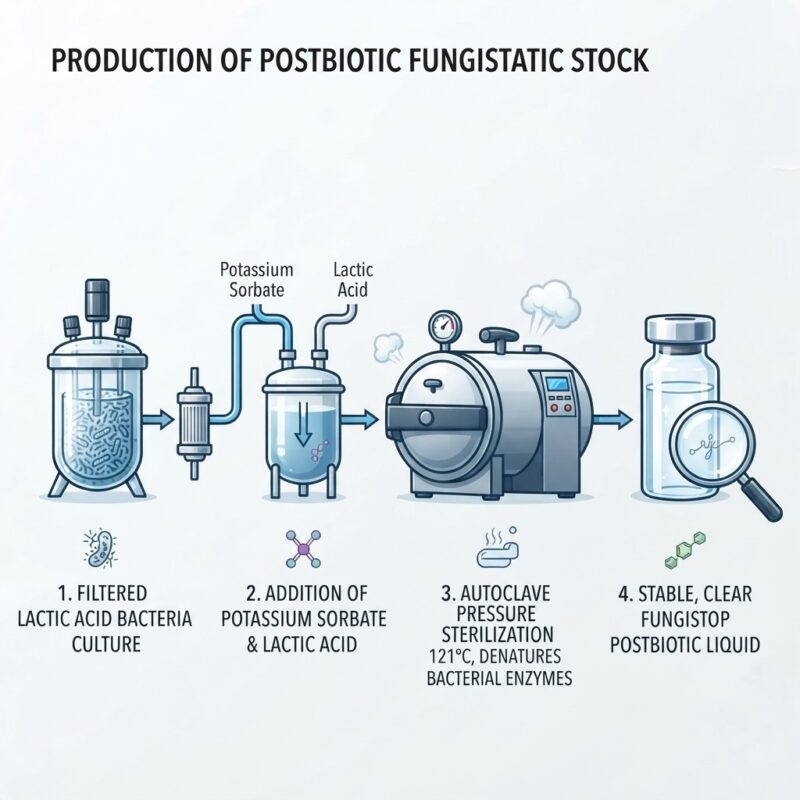
This thermal step accomplishes three distinct objectives:
- Enzyme Denaturation: Completely inactivates all native bacterial enzymes, preventing any future metabolic breakdown of sorbic acid.
- Vegetative Cell Inactivation: Kills off live bacterial populations, halting further fermentation, gas build-up, and carbohydrate consumption inside sealed containers.
- Chemical Preservation: Because both lactic acid, ascorbic and sorbic acid exhibit high thermal stability (up to 140C), pressure sterilization or atmospheric steaming leaves the active antimicrobial molecules completely intact.
Dosing Framework and Target Applications
Because the Lactic Acid + Potassium Sorbate (LA+PS) system acts as a preventative fungistat, application protocols must focus on timing and preventative placement before fungal spores germinate.
| Application Target | Active Sorbate Addition Target |
| Stored Liquid / Ferment Lock | 0.10% w/v (1,000 ppm active) |
| Foliar Surface Preventative Spray | 0.05% w/v (500 ppm active) |
| Post-WIP Produce Dip / Wash | 0.02% – 0.05% w/v (200-500 ppm) |
1. Liquid Extract Preservation ( Active Sorbate)
To prevent wild yeast re-fermentation and surface mold scum in stored liquid ferments or extracts, adjust the liquid pH to < 4.5 using Lactic Acid, then introduce Potassium Sorbate at a rate of active sorbate per Litre of liquid (). This halts spore development without requiring harsh chemical oxidizers.
2. Foliar Surface Protection ( Active Sorbate)
To prevent airborne mold spores (such as powdery mildew or Botrytis) from establishing on leaf surfaces, apply a preventative spray delivering 0.5 g active sorbate per Liter of water ( active) buffered with lactic acid to . Combining this mix with a non-ionic surfactant ensures an even fungistatic film across leaf surfaces.
3. Post-Harvest Produce Rinses ( Active Sorbate)
For extending the shelf life of harvested produce, submerge clean fruits or vegetables in a buffered LA+PS wash ( active sorbate) for 30–60 seconds. Once dry, the invisible micro-film remains on the cuticle, preventing ambient fungal spores from germinating during storage.
Conclusion
The combination of Lactic Acid and Potassium Sorbate provides a refined, preventative mechanism for biological preservation. By maintaining a solution , potassium sorbate is fully converted into its active un-dissociated sorbic acid form, disrupting fungal spore energy metabolism and preventing germination. Thermal processing eliminates enzymatic breakdown, creating a stable, persistent fungistatic barrier that protects liquid formulations and agricultural produce from fungal spoilage.
Pasteurizing Bio-Engineers
Plant-Available Nutrients
Selective Nutrition
Bundu Teq Hub
5 Socratic Questions
- Why is potassium sorbate ineffective at eradicating established vegetative fungal mycelium?
- How does solution pH dictate the concentration of un-dissociated sorbic acid?
- What intracellular mechanism causes fungal spores to exhaust their ATP when exposed to sorbic acid?
- Why must live Lactic Acid Bacteria be heat-inactivated before long-term storage with sorbate?
- What is the primary functional difference between an oxidizing sanitizer and a fungistatic barrier rinse?
-
STS
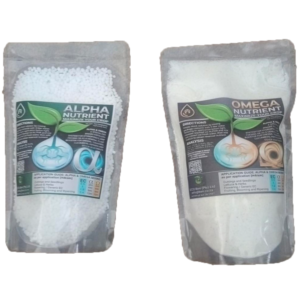
Binary Hydroponic Nutrient Kit – 2 x 5L Concentrates
Original price was: R275.R149Current price is: R149. Add to basket🌱 Makes 2 x 5L professional nutrient concentrate
🌱 Binary Alpha & Omega formula prevents nutrient lockout
🌱 Complete macro & chelated micronutrients
🌱 Professional hydroponics made simple -
STS
Flow-Through Vermicomposting Course
Original price was: R2,200.R995Current price is: R995. Add to basket📖 Master the efficient CFT system!
📖 Learn to build and scale odour-free worm farms
📖 Includes Permanent Access to live, updated content.
📖 Turn organic waste into black gold. -
STS
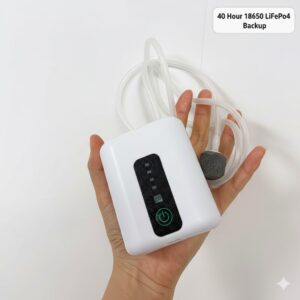
Fermentation Aerator (2.5W) | 40H Backup & NRV
Original price was: R450.R395Current price is: R395. Add to basket🪱 Powerful 2.5W motor with 2.3 L/min output for deep aeration.
🪱 Integrated 18650 Lithium battery: 40H runtime for off-grid use.
🪱 Includes 3m Silicone tubing, Air Stone, and NRV backflow valve.
🪱 Dual Mode: Continuous brew or Pulse-Preserve. -
STS
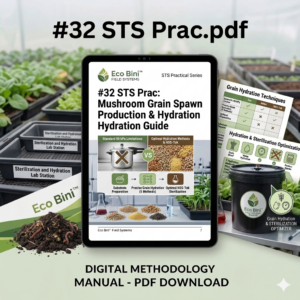
#32 STS Prac: Mushroom Grain Spawn Production & Hydration Guide (PDF Download)
Original price was: R450.R149Current price is: R149. Add to basket🧫Learn five grain hydration methods + NSS-Tek
🧫Decode no-US 80 kPa pressure cooker limitations
🧫Trichoderma / Endospore Trouble Shooting
🧫Why grain spawn hits a metabolic cliff