Throw out the textbook – evaluate the true mechanical advantages of the 6 core hydroponic system classes
Summary
before building your footprint. This lab note looks at modern hydroponic systems. It deconstructs the physical limits of NFT, DWC, RDWC, Kratky, Wick, Ebb-and-Flow, Dutch Bucket, and Aeroponic architectures. Furthermore, it shows our paradigm shift away from old-world “sterile” hydrocarbon based nutrient solutions into living organic system in VermiPonics.
1. Introduction
One of the first questions new growers ask is surprisingly difficult to answer:
“Which hydroponic system should I build?”
Search online and you’ll quickly discover dozens of different names—NFT, DWC, Kratky, Dutch Buckets, Wick Systems, Aeroponics, Fogponics, Bubble Buckets, RDWC, Bato Buckets, Flood-and-Drain…
It feels as though every system is completely different.

In reality, they are not.
Almost every hydroponic system ever built belongs to just six engineering families, each solving the same problem in a different way:
How do you deliver water, nutrients and oxygen to plant roots?
Once you understand those six families, every other design becomes simply a variation on one of them.
This Lab Note compares the strengths, weaknesses and practical applications of each system to help you choose the right architecture before spending money building it.
2. The Six Types of Hydroponic Systems
Every
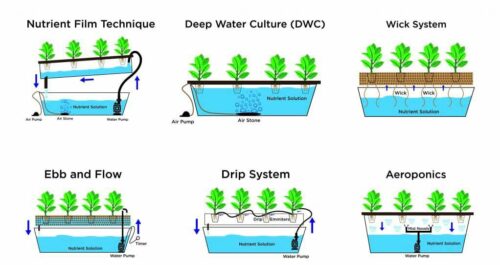
Every hydroponic system is simply an engineered matrix designed to deliver two essential elements to a root zone simultaneously: water-soluble mineral ions and dissolved atmospheric oxygen (O2). How a system manages the fluid dynamics of this delivery determines its operational energy cost and vulnerability to mechanical failure.
- Constant Film: NFT (Nutrient Film Technique)
- Mass Submersion: DWC / RDWC / Kratky
- Passive Capillary: Wick Systems
- Dynamic Flood: Ebb and Flow (Bell Siphon)
- Targeted Drip: Dutch / Bato Buckets
- Atomized Spray: Aeroponics / Fogponics
1. Nutrient Film Technique (NFT)
- Fluid Dynamics: A continuous, shallow stream of nutrient solution—retaining a strict depth profile of just 2mm to 5mm—is pumped down a sloped rigid PVC channel (angled at a to slope).
- Aeration Vector: The upper half of the root mass is exposed directly to the open air within the channel, while the lower half feeds from the shallow mineral film.
- Failure Modes:
- Extremely narrow operational thresholds. Because the system holds zero reserve volume, any electrical interruption or pump failure will dehydrate and kill the entire crop canopy within hours.
- Root mass accumulation inside narrow profiles frequently causes internal fluid dams, leading to channel overflows.
- Strictly limited to small, low-mass crops like herbs and lettuce.
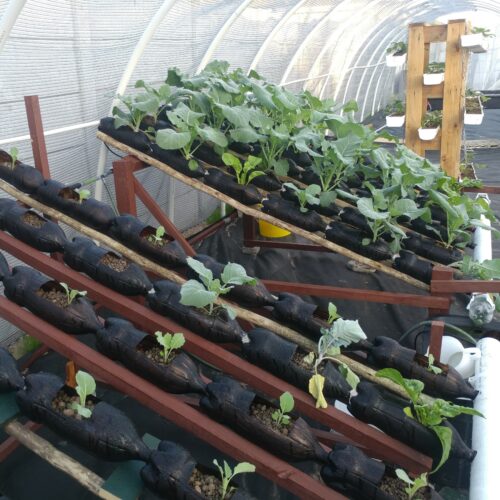
Our first hydroponic system [CBB-Tek] was originally based on NFT.
2. Deep Water Culture (DWC) & Variations
- Fluid Dynamics: Roots are continuously and completely submerged in a massive, static body of nutrient solution. Crops are suspended at the surface on floating rafts.
- Aeration Vector: Forced atmospheric air injection via dedicated mechanical air pumps and porous stone diffusers.
- The Variations:
- Kratky Method: A completely passive non-active system. The reservoir is filled once; as the plant consumes the liquid, the dropping water line naturally creates an increasing “air gap” where specialized atmospheric roots develop.
- Recirculating DWC (RDWC): Links multiple large cultivation buckets to a centralized master reservoir via high-volume piping, using a continuous inline pump loop to equalize nutrient concentrations and dissolve oxygen uniformly across heavy-feeding fruiting crops (Tomatoes, Peppers).
- Failure Modes: Standard DWC is highly energy dependent. If power drops, the massive submerged root zone rapidly strips the remaining dissolved oxygen from the stagnant water, triggering an immediate anaerobic shift where destructive, Pythium (root-rot) bacteria thrive.
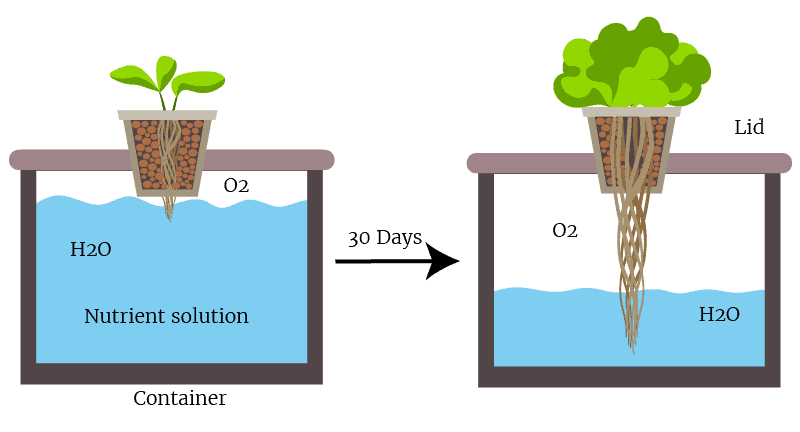
In 2009 Bernard Kratky proposed the ‘Kratky’ method which is based on DWC, but no active parts. On starting growing the water level is up to the bottom level of the net-pots but as the water is used the growing roots will be exposed for aeration.
3. Passive Wick Systems
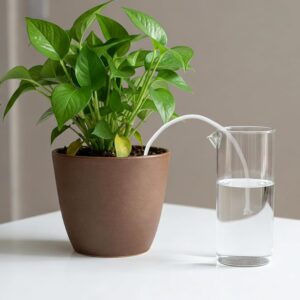
- Fluid Dynamics: A completely passive sub-irrigation architecture. Plants reside in an inert, porous aggregate (perlite, vermiculite) that sits directly above a static, non-circulating nutrient reservoir.
- Aeration Vector: Capillary action draws fluid upward through high-surface-area fibrous wicks (such as self-watering cord), pulling fresh air down into the substrate pores as the moisture is transpired by the canopy.
- Failure Modes: Severe mineral salt scaling at the upper substrate layer due to surface evaporation. Highly unsuited for large, high-transpiration crops, but an elite, zero-energy configuration for seedling germination and localized propagation runs.
4. Ebb and Flow (Flood & Drain)
- Fluid Dynamics: A high-volume cultivation tray filled with loose aggregate (LECA or coarse gravel) is intermittently flooded to maximum capacity by a timed submersible pump, after which the entire volume drains back into a lower reservoir.
- Aeration Vector: The physical drainage phase acts like a massive mechanical piston, pulling a wave of fresh atmospheric oxygen deep down into the root zone every time the water recedes.
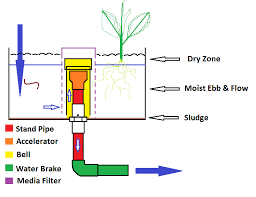
- Mechanical Automation (The Bell Siphon): Rather than relying on unreliable digital timers or electronic valves, the system can be driven purely by fluid pressure via a static Bell Siphon. As the water hits the apex of an internal standpipe, it creates a hydraulic seal that automatically triggers a high-speed siphon loop, rapidly draining the bed until air enters the lower breather holes to break the vacuum.
- Failure Modes: Requires massive system water volumes to execute the flood cycle. High risk of root rot if aggregate media fails to drain fully, and prone to rapid pH shifts within the reservoir due to constant aggregate-to-fluid contact surfaces.
5. Dutch (Bato) Buckets
- Fluid Dynamics: Adapted directly from industrial European and Israeli field practices. Individual cultivation blocks are lined up sequentially along a common drainage line. A centralized pump applies a low-pressure drip feed to the top of each bucket, which gravity-drains through an internal siphon elbow.
- Aeration Vector: The drainage elbow is designed to retain a permanent 25-40mm safety reservoir of water at the very bottom of the bucket, leaving the upper 80% of the aggregate media highly aerated and moist.
- Failure Modes: Clogging of micro-drip emitters by mineral scaling or fine media particles. However, the internal water reserve provides a massive structural buffer against pump failures.
6. Aeroponics & Fogponics
- Fluid Dynamics: Roots are suspended completely naked inside a sealed, dark chamber, with no solid aggregate medium whatsoever. High-pressure pumps drive nutrient solutions through atomizing nozzles to spray the root zone with a micro-fine mist. Fogponics adapts this by utilizing piezo-electric ultrasonic transducers to generate a ultra-low-micron dry fog.
- Aeration Vector: Maximized. The roots are constantly suspended in open, oxygen-saturated air.
- Failure Modes: High technical overhead. The total lack of substrate means that any single nozzle clog, electrical trip, or pump failure will cause immediate, catastrophic crop death within minutes. Requires advanced sensory monitoring loops (IoT) to ensure commercial viability.
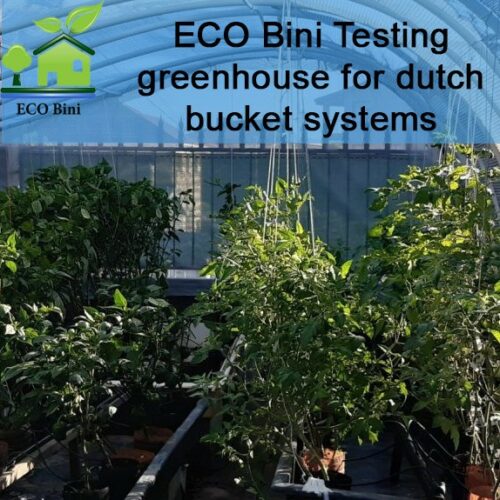
3. The STS Low-Tek Option: Vermiponic Dutch Buckets

When operating on an urban farm or managing an off-grid installation, configuring high-maintenance systems like pure space-grade Aeroponics or continuous-power NFT is a severe strategic liability. To defeat the localized operational threats of power grid instability (“loadshedding”), the STS methodology implements a highly modified, robust Hybrid Dutch Bucket Array utilizing locally sourced materials for VermiPonic Cultivation (Organic Hydroponics).
Quick Note: In this system water is drip fed in the annulus between the Dutch bucket and bag with vermiponic media. This combines bottom feed with Bato bucket principles for a Organic Hydroponic Solution.
Practical Hydroponic notes:
- The Container Profile: Select heavy-duty, straight-sided square buckets. Straight walls allow for seamless media extraction and root-ball clearing at the end of a heavy production season. If using semi-translucent or clear containers, you must coat the exterior surfaces in opaque paint to prevent light penetration from fueling massive internal algae blooms.
- The Siphon Placement: Drill your outlet drainage holes exactly 25 mm (1 inch) up from the absolute bottom of the bucket container.
- The Stratified Media Bed: Fill the bottom 25 mm of the container with clean, coarse 19 mm drainage gravel. This forms a fluid channel around your siphon outlet, and ballast for container. In container place a bottom-perforated HDPE bag and fill with Vermiponic Media. The media acts as Terra Preta soil, with full Soil Biome, or BAM!.
- The Low-Energy Irrigation Schedule: Because the bottom 25mm gravel layer retains a permanent pool of nutrient solution, the Vermiponic Media pulls moisture upward via capillary action. You do not need to pump water continuously. Configure a simple, cheap mechanical 24-hour pin timer to run your delivery pump for just 15 minutes every 4-6 hours. In peak summer heat, simply scale this up to hourly 15-minute bursts during peak afternoon transpiration heat.
- Thermodynamic Stabilization: Bury your main liquid nutrient reservoir directly into the ground. Soil acts as a massive thermal heat sink, keeping your water temperatures cool and stable, which significantly maximizes the fluid’s natural ability to hold dissolved oxygen while suppressing root-zone pathogens.
- The Delivery Lines: Ensure all supply feeds and return lines utilize high-density, black opaque tubing to completely deny light to the water stream, neutralizing plumbing scale blocks before they can initiate.
Conclusion: System Resilience Equals Yield Security
[ Pure Sterile Nutrients ] + [ Constant Power Reliance ] ===> High Supply Chain Vulnerability
                                       VS.
[ Bio-Inoculated BAM! ]  + [ Hybrid Safety Reservoirs ] ===> Total Farm Sovereign Security
Selecting a hydroponic system architecture is not about picking the trendiest technology; it is an exercise in engineering risk management. Transitioning your infrastructure to a bio-inoculated, VermiPonic hybrid array strips the complexity out of your farm footprint, safeguards your investment against immediate electrical or mechanical grid failures, and hands you total control over production outputs.
Further References:
-
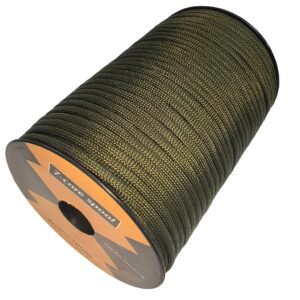
4mm Heavy-Duty 7-Core Lashing Cord (Per Meter)
R9 Add to basket🪱Heavy-Duty 7-Strand Core Lashing Cord
🪱Resistant to moisture, UV rays, and friction
🪱4mm Diameter & Heavy-Duty Wear
🪱Sold per Meter -
STS
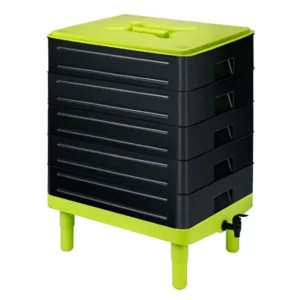
105L 5-Tray Vertical Worm Farm
Original price was: R6,299.R4,995Current price is: R4,995. Made to Order🪱 Large 105L volume vermicomposter!
🪱 5-tray stackable bin for recycling kitchen waste.
🪱 Includes auxiliary tools.
🪱 Suitable for both indoor and outdoor use. -
STS

LAB-X: Food to Farm Master Culture Expansion Kit
Original price was: R320.R225Current price is: R225. Add to basket🧫 Complete 1L food-grade LAB expansion system
🧫 Pure whey-refined mother culture starter
🧫 Dual-use for culinary ferments & soil biology
🧫 Ionic stasis matrix for 24-month shelf life -
STS
Self-Irrigating Capillary Wicking Cord – 10 meter
Original price was: R140.R115Current price is: R115. Add to basket🌱 High-performance 4mm capillary cord.
🌱 Consistent, self-watering moisture delivery.
🌱 Wicking water in self-watering planters, hydroponic seedlings
🌱 Automation-free vacation watering.
Socratic Questions
how to build a hybrid dutch bucket systemdifference between kratky method and deep water culturehow to calibrate a bell siphon for ebb and flowwhy sterile hydroponics fails against root rotusing sawdust as a hydroponic growing medium