Cordyceps militaris requires a specific nutrient “broth” and precise light-timing to transition from vegetative growth
Summary
to the production of high-value medicinal stroma (fruiting bodies). Discover the fascinating world of the “Zombie Mushroom.” This note covers the specialized growth techniques for Cordyceps militaris, focusing on how substrate composition and environmental cues trigger the infection-like fruiting cycle.
Introduction
Cordyceps, also colloquially known as the ‘Zombie Mushroom’… This mushroom infects insect and worms among others, forcing the insect to go ‘up’ to the light/tree-tops…
Thus an insect would crawl up a tree to topmost branches and from there the mushroom would sprout and so increase distribution range and chances of infecting another insects.
There over 400 variants found globally, each with specific host, and more found continually. Actually this number now closer to 600 and have been found infecting from worms to spiders, even the Carpenter Ant of the Amazons fall prey to this Fungi.
Cordyceps hit the headlines in 1993 during the Beijing Olympic games when several Chinese runners smashed various world records and attributed their success to eating Cordyceps mushrooms.

Cordyceps Sinensis
This is the ‘original’ cordyceps, and only occurs in the Tibetan Highlands [3000-5000m] and infects only Himalayan Ghost Moth caterpillars. Artificial cultivation has not been achieved yet of the fruiting bodies, only submerged liquid culture of mycelium. [Called CS4]. Many households in Himalayan region main income is harvesting wild Cordyceps Sinensis, which has become vulnerable, especially since it is worth more than the value of gold.
It is the compound Cordycepin, a derivative of the nucleoside adenosine, that helps improve blood flow as well as the body’s ability to burn fat and process glycogen (glycogen is the carbohydrate energy stored within our muscles). Together these effects increase the availability adenosine triphosphate (ATP) in the body, ATP is the source of energy the body uses to power the contraction of muscles.
Cordyceps Militaris
With several further studies and demand for the limited Cordyceps Sinensis strain, it was found that the Northern China Caterpillar fungus [or Cordyceps Militaris] could be artificially cultivated. Originally they were grown on silkworm pupae.
Through selective breeding and selection the cordycepin level has increased to be comparable to Cordyceps Sinensis – and in the Taiwanese version even higher with correct substrate.
Though the benefits of cordyceps has been established for athletes with various studies done, it is only recently that been proven to boost immune system.
Growing Cordyceps
Grow Cordyceps Militaris in polypropylene containers, in this way there is little chance of contamination getting in. It is virtually a self-enclosed ‘Terrarium’ that protects the mycelium akin to an insects body.
Cordyceps is a very complex organism. Almost like a coral reef with up to 600 different fungi present in Cordyceps Sinensis. Yet on the other hand and maybe because of complexity it is comparably easy to grow with correct substrate as the container keeps out contaminants and the CM virility is so high that is resistant to contamination and have had yield with contaminated sections.
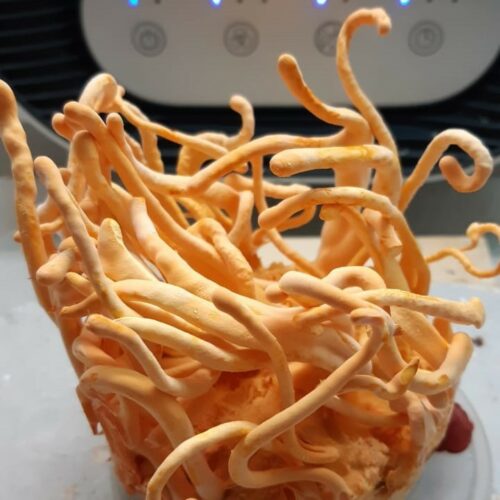
In the East there are large farms/warehouses dedicated to Cordyceps cultivation. For the initiate cultivator though using 750ml Polypropylene bottles advised. As your cultivation experience increases then can expand operation to first inoculating in large spawn bags then transferring the colonized substrate to grow trays.
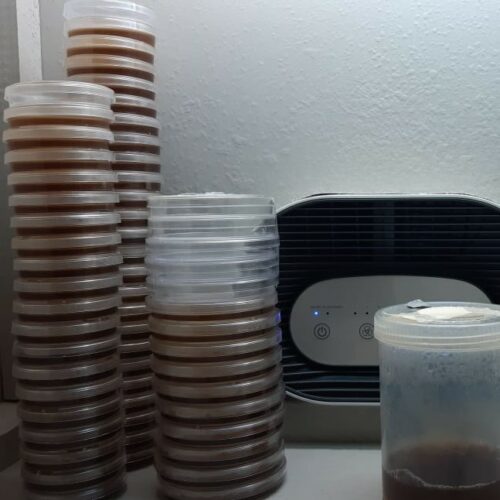
Making a cultivation Culture
As you just want to clone and grow your sample, nothing special required and PDA [Potato Dextrose Agar] been used traditionally. Go to Working with Agar page for recipes. Cordyceps Militaris mycelium is very virulent and will grow on most recipes. Due to the complexity of this fungal type there is one downfall and that is Senescence, or ‘aging’, which will grow by not fruit. One school of thought is to change the agar mixture, nutrients, often.
Similarly to making spawn – agar can be used to grow out on the substrate [or even G2G], but the norm is to make a Liquid Culture, this gives many inoculation points and allows quick colonization of substrate. A simple recipe being: 2% Glucose, with 0.5% Nutritional Yeast. The yeast in my experience makes water cloudy and can be replaced with 0.2% Light Malt Extract [LME], which gives a clearer solution. For contaminated LC – the first sign is cloudiness.
After several variations have now standardized to Dextrose and Peptone which gives a crystal clear medium [2% Dextrose and 0.22% Peptone] for Liquid Culture, with small % nutrient salts. The Peptone does make a marked difference as nitrogen source and being water soluble makes a clear solution.
I think maybe it is due to this “Liquid Spawn” variation that LC [or liquid culture] has made such headlines in mainstream cultivation. For me though it is connected to Cordyceps cultivation, as the fungus mycelium has to grow in the insects blood, hence well suited for submerged liquid culture.
Growing fruiting bodies: Substrate and Broth
Cordyceps Militaris can simply be grown on hydrated grain [specifically wheat grain for Taiwan strain]. Sterilize a 4cm layer [bigger tubs 6cm] in container for 1 hour at 1 atmosphere. Remove, cool and inoculate with 5cc of Liquid Spawn.
Disadvantage of only grain, such as prepared for Sinden Spawn, is the lower MC [Moisture Content] of typically 50% – and so thicker layer required to prevent drying out. Another substrate that can be used is whole brown rice, and is preferred method as can have a higher MC of 60%. Now you can also add a broth that is more suitable to the Cordyceps and boosts production of Cordycepin and higher yields. A Biological Efficiency of over 100% is possible.
For South Africa we have found Samp to be a good substrate, naturally high in sugars, and also highly absorbent. You do not want excess “free-standing” water, this leads to anaerobic conditions.
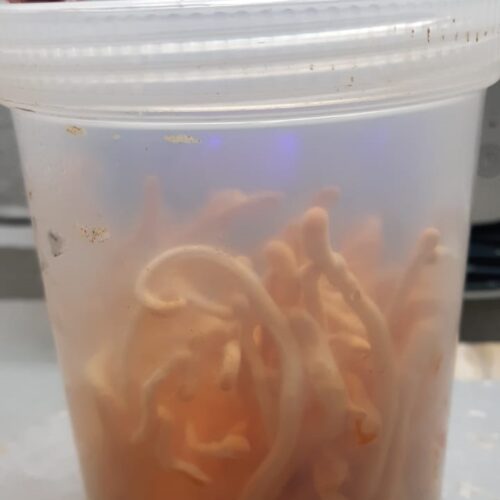
With brown rice the ratio is 1:1 to 1:1.6. Therefore for every 10g Rice you will add 10 – 16 ml broth, and sterilize for an hour. Being such small amounts normally, and high moisture content, it has been found that normal PC [or InstantPot] will do.
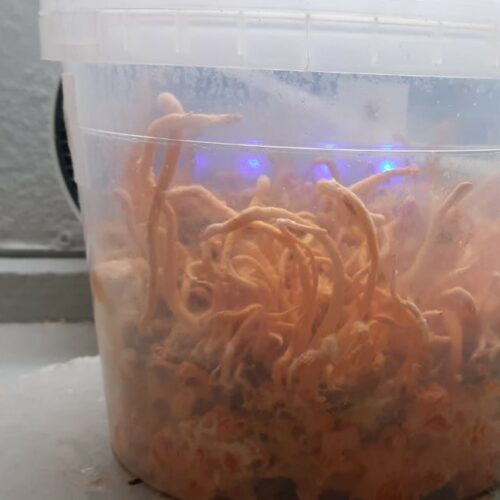
For 10 cm diameter tubs [such as 750 ml tub in picture], following procedure being used:
- 3 TBS Brown Rice [38 g]
- 4 TBS broth [60 ml]
Broth, simplest broth, is as follows:
- 1 litre Potato Extract [as making PDA, without the agar]
- 10 g light malt extract
- 5 g Nutritional Yeast
We have now released a broth premix which contains Glucose, Peptone, Yeast extract and essential salts to promote Cordycepin production on grain substrate.
Sterilize container and contents, allow to cool overnight, and inoculate with 5 cc of Cordyceps liquid culture.
Cordyceps Cultivation
After inoculation put in dark place [very important as Cordyceps is phototropic] until fully colonized. Cordyceps is quite vigorous and will fully colonize with a brilliant white mycelium with 5-7 days. This can vary according to strain, but do not leave too long in dark so that grows a mycelial mat on top. This has been found to hamper fruit body formation – and have heard of growers actually skipping this step and putting straight to fruiting conditions [light] after inoculation.
Once the substrate fully colonized then can expose to fruiting conditions. Witch for Cordyceps is simply a light cycle of 15 hours at 300-500 lux at room temperature until turns orange and pins form – then can lower light to 12 hours a day. Cordyceps is a cooler weather grower and keep temperatures below 20 Celsius for optimal yields.
Harvest Cordyceps Militaris within 50-70 days, before tips become white with spores, as this the end of life cycle.
NOTE: Cordyceps cultivation was listed as easy due to following reason:
- Growing in enclosed container, so external contamination is minimal
- With high liquid content substrates, adding broth to rice, sterilisation can be done in normal InstaPot.
- Fast vigorous colonizer, with Liquid culture the speed is such that grain contaminants outcompeted.
- In enclosed container no not need to control ambient humidity – only light exposure, and not a lot at that.
But there are a couple of factors that learnt the hard way. This list far from complete, lost my culture, due to unforeseen circumstances:
- The Senescence factor. So would advise for the aspiring cultivator to continually keep their culture alive by cloning. I battled months to get clone back from a sample had on slant fortunately.
- Light Factor. Need the 14-15 hour window light for pinning, in current South African loadshedding scenario, impossible. This is first and foremost to be included in your CEA aspirations. If you do not have the light duration then a thick matt will form, but no pins will initiate. Reason for some cultivators to put straight to low level light.
- Height Factor. Do not know how this influences, but will not grow in Jars above 140 cm? I have had high yields in 13cm high 750 ml screw tubs and even the 1L tamper-proof tubs. But no growth in a 17 cm high tub. In the East they are grown extensively in shallow trays. The only reason I can give for this is CO2 and insufficient FAE [Fresh Air Exchange] if the grow container is too high.
-
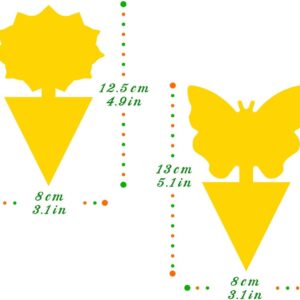
Yellow Sticky Fruit Fly & Fungus Gnat Traps
R11 Select options This product has multiple variants. The options may be chosen on the product page🏗️Bright yellow colour attract flying insects
🏗️Odourless, Safe and Non-toxic
🏗️Durable – UV resistant and Waterproof
🏗️Easy to Use, Plant and Peel -
Organic Elephant Garlic Rounds (Ajo Macho / Solo Garlic)
R90 Read more🌱 Large, mild-flavoured single Ajo Macho bulbs
🌱Organic Elephant Garlic Rounds / Pearl / Solo
🌱 Vernalized for immediate planting or roasting
🌱 Seasonal – Limited Stock -
STS
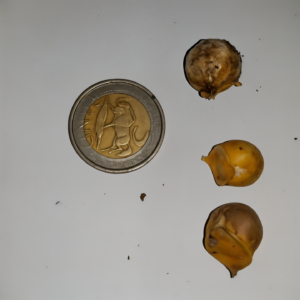
Organic Elephant Garlic Corms (Heirloom)
Original price was: R135.R95Current price is: R95. Add to basket🌱 Start your Elephant Garlic journey.
🌱 Grows into Ajo Macho Solo Round.
🌱 Perennial plant and natural pest deterrent.
🌱 Limited Stock – 20 off per pack -
STS
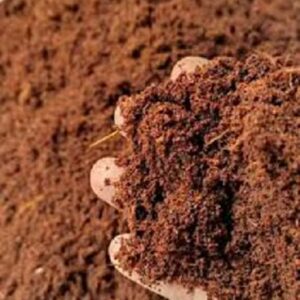
STS “Buffer-Charge” | Professional 5kg Coco Coir Conditioner
Original price was: R39.R30Current price is: R30. Add to basket Stop “washing” your coir and start charging it.
Pre-measured, dry-sachet conditioning system.
Removes the natural sodium and potassium salts in coco coir.
Provides an engineered environment for your plants to thrive from day one.
Socratic Questions:
- How does Cordyceps militaris infect its substrate?
- What is the best nutrient broth for Cordyceps?
- How to grow Cordyceps mushrooms for medicinal use?
- What environmental triggers cause Cordyceps to fruit?
- Is Cordyceps militaris safe for human consumption?