
Learn the exact mathematical formulas used to track individual nutrient in parts per million.
Summary
This advanced Lab Note strips away the guesswork of blended fertilizers. It delivers a masterclass on the fundamental metric laws of hydroponic math , breaks down the hidden elemental percentages on commercial fertilizer labels.
1. Introduction: Moving Beyond Blind Blends
Many hydroponic hobbyists treat nutrient management like alchemy. They pour pre-mixed liquid bottles into a reservoir, stir blindly, dip a digital meter, and pray the resulting number keeps their plants alive. This uncalibrated approach works fine for small-scale backyard systems, but it fails completely when scaling up high-biomass crops or running resource-constrained Bundu Tek arrays.

To unlock true optimization, a professional grower must move past total solution strength and look directly at individual elemental concentrations.
Parts Per Million (PPM) isn’t just a number on an instrument screen; it is a direct metric measurement of physical weight. By mastering the mathematical laws of stoichiometry, you can map out the exact mass of individual elements entering your irrigation lines before your water even touches a dry fertilizer salt.
2. The Core Law of Hydroponic Math:
The entire framework of advanced nutrient calculations rests on a single, elegant metric relationship. Because 1 Litre of pure water has a physical mass of exactly 1 Kilogram (1,000,000 milligrams), any solute dissolved inside that Litre scales at a perfect one-to-one-millionth ratio.

This baseline principle means that if you know how many milligrams of pure, raw element are dissolved in a Liter of water, you automatically know your exact elemental PPM. The execution variables are incredibly simple:
- The Mass of the Nutrient Input (measured in milligrams).
- The Volume of the Solvent Water (measured in Liters).
And this is the main reason why we get PPM meters, unfortunately most of them are for simple salt, with TDS = Total Dissolved Salt (NaCl).
But in calculation it easy as 20g calcium in 5 Litres of water is 4000 PPM – will leave it up to you to check. So, if we know the amounts of salt we adding to a specific volume of water, we can determine the final PPM just by adding the separate salt PPM’s.
3. Demystifying the Fertilizer Label
The primary barrier to calculating precise PPM is that commercial fertilizers are never made of pure single elements. Nitrogen, Phosphorus, and Potassium do not float around in stable, dry crystalline forms on their own; they must be bound to carrier molecules (such as Calcium or Sulfur) to form stable, water-soluble salts.
When you look at a fertilizer label displaying an NPK rating (e.g., your standard Masterblend Tomato formula at 4-18-38), those numbers represent the absolute percentage by weight of those elements locked inside the bag. The NPK, or Nitrogen – Phosphate – Potassium, is the big 3 numbers you will find on any chemical fertilizer.

                                         ┌── 4%  Total Nitrogen (N)
MASTERBLEND 4-18-38 ───┼── 18% Available Phosphate (P)
                                         └── 38% Soluble Potash (K)
To break this down for a spreadsheet calculation:
- Every of that dry powder contains exactly of pure Nitrogen
- If you dump that single gram into 1 Litre of water, you have introduced exactly of elemental Nitrogen to the solution.
4. Operational Application: The Calcium Nitrate Calculation Model
To demonstrate this math in a real-world grow room, let’s look at Calcium Nitrate. In advanced multi-part hydroponic configurations, Calcium Nitrate is systematically separated into its own concentrated stock tank (Tank A). If concentrated Calcium is mixed directly with concentrated Phosphates or Sulfates, an immediate chemical reaction occurs, forming highly insoluble Calcium Phosphate or Calcium Sulfate (gypsum), which drops out of the solution as a white sludge, causing a catastrophic nutrient lockout.
A standard commercial bag of greenhouse-grade Calcium Nitrate typically features a standardized breakdown of 15.5% Nitrogen (N) and 19% Calcium (Ca).
                                                   ┌── 15.5% Nitrogen ──> 155mg N  ──> 155 PPM N
1 Gram Calcium Nitrate in 1L H2O ─┤
                                                   └── 19.0% Calcium  ──> 190mg Ca ──> 190 PPM Ca
                                                                   ────────────
                                                                    Total: 345 PPM
The Calculation Walkthrough:
If we dissolve exactly of clean Calcium Nitrate powder into 1 Litre of distilled water, we can instantly calculate the elemental breakdown without turning on a probe:
- Isolate the Nitrogen Mass:
- Isolate the Calcium Mass:
- Convert to PPM: Because our water volume is exactly 1 Litre, these weights translate directly to concentration values:
- of Elemental Nitrogen
- of Elemental Calcium
- Total Mass Check: The total combined mineral input contribution of this single gram adds exactly of active, bio-available fertilizer nutrition to your water lines.
While calculating a single compound like Calcium Nitrate is straightforward, a complete scientific recipe like the Hoagland Solution requires tracking 13 separate elements shifting simultaneously across multiple salts (Potassium Nitrate, Monopotassium Phosphate, Magnesium Sulfate, and trace chelates).
Because many of these salts carry overlapping elements (for example, both Potassium Nitrate and Monopotassium Phosphate introduce Potassium), doing these calculations by hand on a notepad will quickly lead to mathematical errors.
To run a successful soil-less system on a budget, building a rudimentary spreadsheet matrix is essential. By mapping your compound percentages into a digital sheet, you can instantly tweak your gram weights to adjust your target PPM profiles as your crop moves from its vegetative leaf cycle into heavy fruiting and flowering blocks.
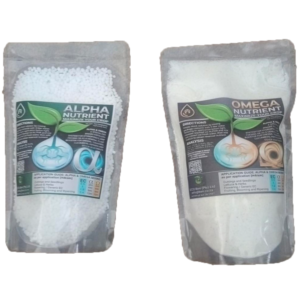
We have done all this and went and put all together in Alpha and Omega binary DIY nutrient kit.
Conclusion: Take Total Control of Your Inputs
[ Traditional Guesswork ] ---> [ Unbalanced Ratios ] ---> [ Poor Yields & Plant Stress ]
                                                         VS.
[ Stoichiometric Math ]   ---> [ Tailored PPM Profiles ] ---> [ Maximum Genetic Potential ]
Mastering stoichiometric calculations transforms you from a basic consumer buying generic, diluted retail liquid bottles into a sovereign agricultural engineer. It allows you to buy pure, raw, technical-grade dry mineral salts in bulk, formulate your own premium targeted crop feeds, and diagnose subtle deficiency profiles with absolute mathematical certainty.
To calculate the PPM (parts per million) of a hydroponic nutrient solution, first determine the concentration of each nutrient in the solution, typically measured in milligrams per liter (mg/L). Then, sum the concentrations of all nutrients to find the total nutrient concentration. Since 1 mg/L is equivalent to 1 PPM, the total concentration in mg/L directly translates to PPM.
If you want to skip the spreadsheet setup entirely while still taking advantage of precision laboratory ratios, we have pre-calibrated these exact stoichiometric weights for you. Our Alpha 2 Omega Dry Mix, available on the SPeS store, is calculated to match the exact elemental PPM ratios required for premium crop performance. Simply dissolve, apply, and watch your canopy reach its maximum genetic potential.
Ready to see how environmental variables like temperature, humidity, and atmospheric load alter how your crops drink these calculated PPM profiles? Advance to the next chapter in our masterclass: [Lab Note #116: Environmental Dynamics and Daily Reservoir Balancing Protocols].
-

Potato Grow Bag – Heavy Duty (38L) with Harvest Flap
R149 Add to basket🌱 Grow Potatoes anywhere!
🌱 UV-resistant 38L bag with easy-harvest flap.
🌱 Reinforced handles, and aeration holes.
🌱 Ideal for small urban spaces. -
STS
Binary Hydroponic Nutrient Kit – 2 x 5L Concentrates
Original price was: R275.R149Current price is: R149. Add to basket🌱 Makes 2 x 5L professional nutrient concentrate
🌱 Binary Alpha & Omega formula prevents nutrient lockout
🌱 Complete macro & chelated micronutrients
🌱 Professional hydroponics made simple -
STS

Alpha & Omega [Kratky & Passive Hydro] Nutrient Kit – 2x 500ml
Original price was: R195.R95Current price is: R95. Add to basket🛠 Dual-part liquid Kratky hydroponic nutrient concentrates
🛠 Refined Hoagland solution pre-dissolved in 2x 500ml UV-opaque white bottles
🛠 perfect for passive indoor herb gardens — Just Dose and Grow -
STS

Eco Bini™ BioaKt Media/Substrate Conditioner | 2000 ml
Original price was: R195.R149Current price is: R149. Add to basket🏗 Bundu-Tek additive with kelp alginates – No autoclave needed.
🏗 Alkaline pH Pasteurizer
🏗 Self-sterilizing formula
🏗Boost yields and colonizing times
Socratic Questions
how to calculate hydroponic nutrient ppm formulaconvert fertilizer fertilizer percentages to ppmcalcium nitrate fertilizer ppm calculation examplehow to calculate mg l to ppm hydroponicsdiy hydroponic nutrient calculator spreadsheet