The Four Rs are Reduce, Reuse, Recycle and Refine.
Answer
They are the practical engineering principles behind Bundu Teq’s approach to Biological Independence.
Together they turn biological resources, natural processes and waste streams into productive system inputs.
The ultimate objective is to restore the biological processes that make the system increasingly self-sustaining.
Understanding the Four Rs
The Four Rs are not simply environmental slogans. They form the practical framework used to understand, design and manage Bundu Teq systems.
They guide the shift away from linear systems that continually consume external inputs and produce waste, towards biological systems where resources remain useful for as long as possible.
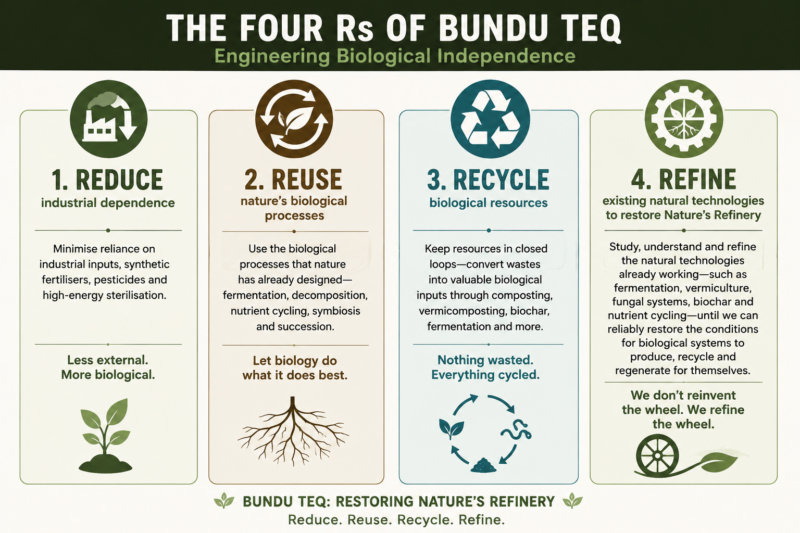
The four principles are closely connected:
Reduce → Reuse → Recycle → Refine
They are not rigid steps that must be completed one after another. They are integrated principles that can be applied throughout the design and operation of a biological system.
1. Reduce — Industrial Dependence
The first principle is to reduce dependence on external industrial inputs.
Modern production systems often solve biological problems by purchasing an industrial product: fertiliser supplies nutrients, pesticides control pests, manufactured growing media provide structure, and energy-intensive infrastructure replaces biological functions.
Bundu Teq asks whether those functions can instead be performed, partly or completely, by the biological system itself.
Reducing therefore does not mean rejecting technology or refusing useful external inputs. It means understanding what the input is actually doing, and then asking whether that function can be achieved more efficiently through biology, recycling or better system design.
2. Reuse — Nature’s Processes and Available Resources
The second principle is to reuse biological processes and resources that are already available.

Nature continuously performs functions that agriculture often attempts to replace with manufactured inputs. Microbes decompose and transform organic matter. Fungi break down complex materials. Plants capture energy and build biomass. Worms process decomposing organic material.
Bundu Teq seeks to put these processes back to work.
Reuse also extends to physical materials. A discarded plastic bottle can become hydroponic infrastructure. Sawdust can become fungal growing substrate. Food waste can become feedstock for biological processing.
The question becomes:
What useful function can this resource perform before it leaves the system?
3. Recycle — Keep Resources Moving
The third principle is to recycle biological resources and nutrients within the production system.
A biological system becomes increasingly independent when its outputs can become inputs somewhere else.
Kitchen waste can become vermicompost. Vermicompost can contribute to plant nutrition. Crop residues can return to biological processing. Spent mushroom substrate can become another organism’s feedstock.
Instead of:
Buy → Use → Discard
the aim is to develop:
Resource → Process → Product → Resource
This keeps nutrients, organic matter, water and other useful resources circulating through the system rather than continually replacing them with new external inputs.
4. Refine — Nature’s Refinery
The fourth principle is Refine.
This is what takes the Four Rs beyond conventional waste reduction or sustainability.
Bundu Teq does not claim to reinvent nature’s technologies. It studies the biological processes that already work — from fermentation and vermiculture to fungal decomposition, biochar and nutrient cycling — and progressively refines them into practical biological systems.
The objective is to restore the functions of Nature’s Refinery by creating the conditions in which those processes can operate effectively, reliably and repeatedly.
Refine existing natural technologies to restore Nature’s Refinery.
That may involve rebuilding microbial activity, restoring organic matter, establishing fungal relationships, improving nutrient cycling, retaining carbon, or reconnecting biological processes that modern production systems have separated.
The objective is therefore not simply to make a damaged system less damaging.
It is to refine our understanding of Nature’s technology until we can engineer environments in which biological systems once again produce, recycle and regenerate resources for themselves.
The Four Rs as an Engineering Framework

The Four Rs work together.
Reduce unnecessary industrial dependence.
Reuse natural processes and available resources.
Recycle nutrients and biological resources through the system.
Refine existing natural technologies to restore Nature’s Refinery.
Together they provide a practical framework for moving towards Engineering Biological Independence.
The Four Rs therefore aren’t four separate sustainability practices. They are a way of looking at a system and asking:
What are we importing? What can biology do? What are we throwing away? And what biological function needs to be refines?
-
STS
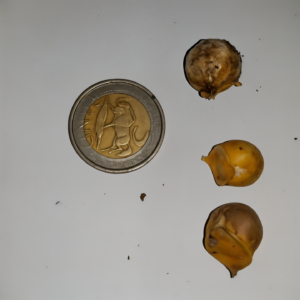
Organic Elephant Garlic Corms (Heirloom)
Original price was: R135.R95Current price is: R95. Add to basket🌱 Start your Elephant Garlic journey.
🌱 Grows into Ajo Macho Solo Round.
🌱 Perennial plant and natural pest deterrent.
🌱 Limited Stock – 20 off per pack -
STS
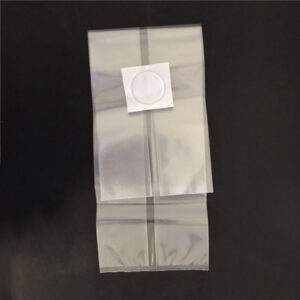
13x12x50cm Gusseted Spawn Bag [0.2μm Filter]
Price range: R15 through R1,146 Select options This product has multiple variants. The options may be chosen on the product page🧫 Commercial-grade 60 Micron Polypropylene
🧫 Non-woven 0.2µm ePTFE filter patch
🧫 Maximum sterility during grain spawn production
🧫 Gusseted design – Autoclavable up to 126°C -
STS
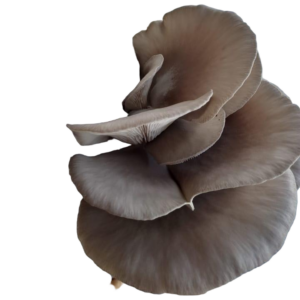
HK-35 Low-Spore Oyster Mushroom Spawn Kit
Original price was: R1,399.R995Current price is: R995. Add to basket✔ Commercial HK-35 Low-Spore Oyster Mushroom
✔ Includes 100 ml Living Inoculant in Reusable Culture Bottle
✔ Includes 1 kg Sterilized Sorghum Grain Spawn with SHIP
✔ Aggressive colonization and reduced airborne spore production -
STS
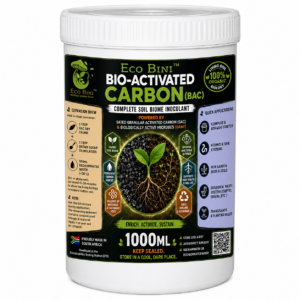
Eco Bini™ BAC: Complete Soil Biome Inoculant
Original price was: R229.R164Current price is: R164. Add to basket🛠Activated BAM! Dry Inoculant
🛠Add Sugar & Water to Activate
🛠High-Density Microbial Matrix
🛠Makes 600L+ Living Probiotic
Socratic Questions
- How do the Four Rs reduce dependence on industrial inputs?
- What is the difference between reusing and recycling resources?
- Can the Reuse principle apply to inorganic materials?
- Why is Refine different from conventional environmental conservation?
- Are the Four Rs sequential principles or an integrated framework?