Stop bleaching your gear and stinking out your lab.
Summary
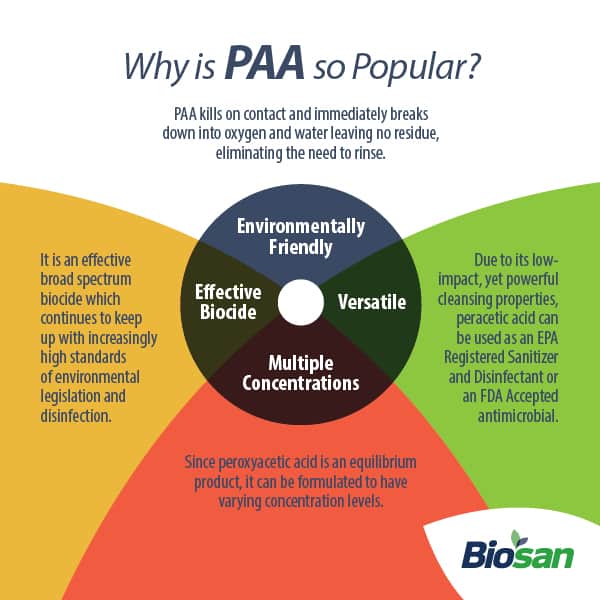
Master the raw chemistry of Peracetic Acid (PAA) to achieve hospital-grade cold sterilization with zero toxic residues. This laboratory brief breaks down the chemical equilibrium of Peracetic Acid. It contrasts PAA against standard farm disinfectants, details its multi-industry application from dairy lines to foliar crop protection, and provides precise dilution targets using the Parts Per Million (PPM) scale.
1. The Chemistry of Living Chemistry
Peracetic Acid (CH3CO3H), or PAA, is not a simple, single chemical. It is a shifting, living equilibrium mixture created by reacting highly concentrated Acetic Acid (the acid found in vinegar) with Hydrogen Peroxide using a strong acid catalyst.
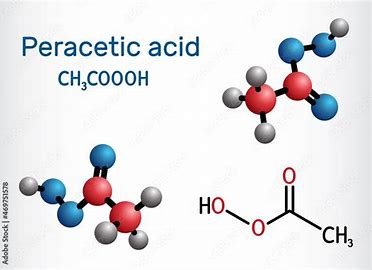
[ Acetic Acid ] + [ Hydrogen Peroxide ] ⇌ [ Peracetic Acid ] + [ Water ]
CH₃COOH + H₂O₂ ⇌ CH₃COOOH + H₂O
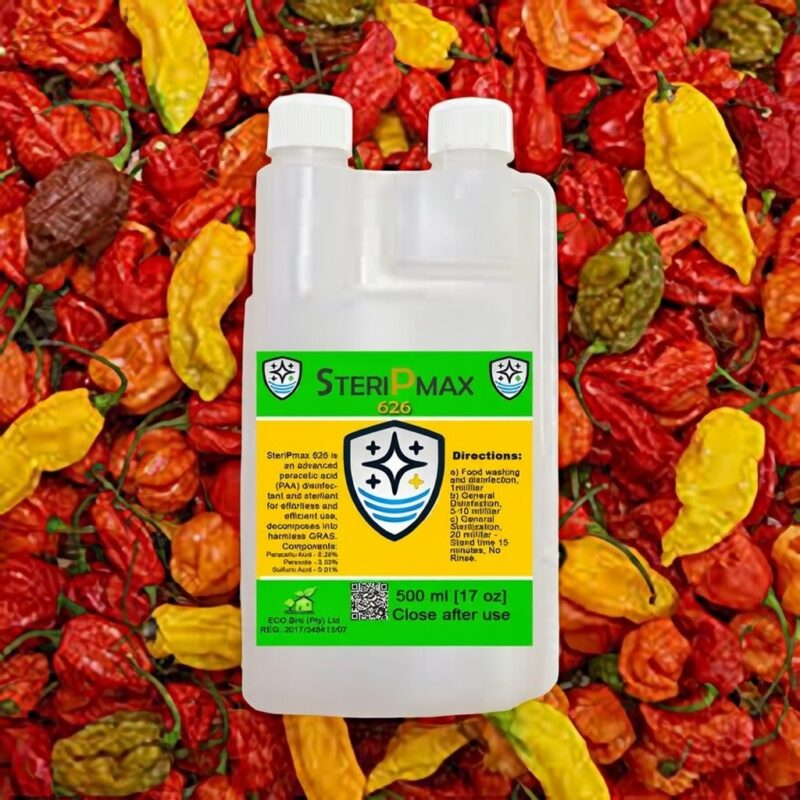
In its concentrated bottle, all four of these components exist together in a permanent balancing act. To keep our baseline concentrate (SteriPmax) locked at a stable 5% strength for a long shelf life, it is formulated with a slight excess of peroxide to continuously push the chemical reaction to the right.
The Biological Burn
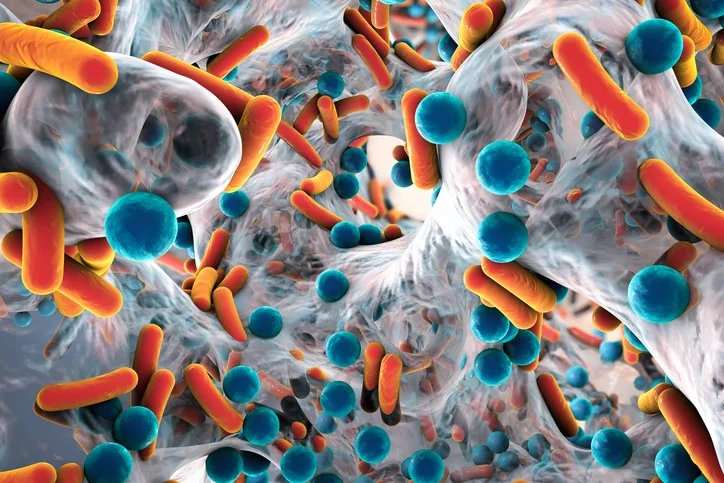
Unlike systemic antibiotics or alcohol, which pathogens can eventually adapt to, PAA destroys microbes through absolute brute force called Oxidation Potential.
When PAA hits a cell wall, it violently rips electrons away from the structural proteins and internal enzymes of the pathogen. At a microscopic level, this acts like an immediate chemical incineration. It blows apart cell membranes and burns through the protective armor of tough bacterial endospores instantly, making it biologically impossible for any virus, fungus, or bacteria to develop a resistance.
The Zero-Residue Profile
The absolute best feature of PAA—and the reason it forms the core of our biosecurity—is how it dies.
When chlorine bleach breaks down, it leaves behind toxic salts and creates carcinogenic chemical byproducts (trihalomethanes). When PAA finishes its biological burn or hits the open air, it completely decomposes into three harmless components: Water, Oxygen, and mild Vinegar.
This makes PAA the ultimate “No-Rinse” sterilizer. It drops into a system, kills every pathogen on contact, and then evaporates into thin air without leaving a single trace of toxic residue behind.
2. PAA vs. The Competition
To run a clean farm or lab, you have to know how your tools stack up. Standard rubbing alcohol and chemical sanitizers carry major operational compromises:
- 70% Ethanol: Excellent for quick surface wiping, but completely useless against fungal or bacterial spores. It also leaves behind a sticky film if you use denatured varieties.
- Chlorine Bleach: Highly corrosive to metals, creates toxic fumes, and leaves behind heavy, oily salt crusts that must be thoroughly rinsed off with sterile water.
- Peracetic Acid (SteriPmax): Liquid and gaseous dual-action sterilization. It destroys spores that bleach misses, leaves zero residue, requires absolutely no rinsing, and is fully biodegradable.
| Feature | Peracetic Acid (PAA) | Bleach | Quats | 70% Ethanol |
| Spore Kill | Excellent | Good | None | None |
| Residue | Zero | Toxic Salts | High (Oily Film) | Minimal |
| Eco-Friendly | Yes (Biodegradable) | No (Fumes/Salts) | No (Aquatic Toxin) | Yes |
| Application | Sterilization | Disinfection | Cleaning | Sanitizing |
| Rinsing | No Rinse | Heavy Rinse | Must Rinse | No Rinse |
3. Cross-Industry Operations: Where PAA Solves Problems
Because PAA is food-safe and completely free of persistent residues, its operational uses span across every phase of sustainable agriculture:

- Food & Beverage Lines: Used globally in Clean-In-Place (CIP) systems to sanitize miles of stainless steel commercial piping without tearing the hardware down. At working dilutions, it will not pit or corrode high-grade stainless steel.
- Water Lines & Biofilm Removal: Bacteria protect themselves by spinning a slimy sugar shield called a biofilm. This slime clogs hydroponic emitters, fouls drip lines, and harbors root-rot pathogens. PAA is one of the few oxidizers aggressive enough to dissolve the biofilm matrix from the inside out, keeping lines clear and water heavily oxygenated.
- Crop Protection & Seed Prep: Pathogens like Pythium (root rot) and Fusarium frequently hitchhike into systems on dirty seed coats or cuttings. A rapid, low-dose PAA dip creates a clean biological slate without harming the delicate seed embryo. As a foliar spray, it halts Powdery Mildew, Blights, and Rust on contact.
- Mycology & Culture Labs: Serves as a high-level “cold sterilization” soak for tools, scalpels, and workspace surfaces where heat autoclaves cannot be used. At low concentration [100PPM] can be added to agar before pouring for Agar SIP.
4. The Master Math: Dilution & PPM Targets
In a professional lab, we do not mix chemicals by “splashes” or “glugs.” We mix by PPM (Parts Per Million) to hit exact biological kill targets.
Because a premium 5% PAA concentrate sits at a massive 50,000 PPM, a very small amount goes an incredibly long way. Use this calibration chart based on mixing into 1 Liter of clean water:
| Application Tier | Target Strength | Concentrate Dose | Contact Time | Primary Operational Use |
| High-Level Sterilization | 2000 PPM | 40 ml per 1L | 10–30 Mins | Destroys stubborn spores, wild yeasts, and viruses on raw tools. |
| Lab & Tool Disinfection | 1000 PPM | 20 ml per 1L | 5–10 Mins | Benchtop wiping, cleanroom prep, and tool-soak tubs. |
| Industrial / Line Clean | 500 PPM | 10 ml per 1L | 10 Mins | Circulating through clogged hydroponic lines and biofilm removal. |
| Submerged Produce Wash | 100 PPM | 2 ml per 1L | 1–10 Mins | Washing harvested produce. No final water rinse required. |
| Agar / System Maintenance | 50 PPM | 1 ml per 1L | Continuous | Drip reservoir maintenance and specialized tissue culture agar plate protection. |
The Bulk Water Rule of Thumb:
If you are managing large volumes, remember this baseline calculation:
- 1 ml of 5% PAA concentrate per 1 Liter of water = 50 PPM of active PAA.
- Example: To hit a 100 PPM produce wash in a 50-liter tank, you need exactly 100 ml of concentrate.
5. The “Freshness Window” & Stability Rules
To get professional-grade results from your solutions, you must respect the difference between the raw concentrate and your diluted working mixtures.

- The Concentrate (The Bottle): Kept in its original container in a cool, dark cupboard (or a dedicated lab fridge), your 5% concentrate will remain stable for 6 to 12 months. PAA naturally releases tiny fractions of oxygen gas over time; if the bottle builds up pressure, simply crack the cap slightly to “burp” the container and retightening it.
- The Working Dilution (The Spray Bottle): The exact moment you mix PAA into water, the chemical equilibrium shifts drastically. The PAA instantly goes to work and begins breaking back down into vinegar and water. Your working spray bottles have a strict 24-to-48-hour potency window. Mix only what you need for that specific day’s work. Never pour used or leftover dilutions back into your main concentrate bottle.
6. The “Per-Alcohol” Synergy Hack
This is our preferred method for small labs and mycology benches to minimize chemical waste:
- Clean: Spray the surface down thoroughly with standard 70% rubbing alcohol to degrease the area, clear dust, and wipe away residues.
- Sterilize: Immediately follow with a fresh 2000 PPM aqueous PAA dilution (40ml per Liter of water).
Leave the surface wet. In a clean space, keeping the surfe wet entraps any falling airborne spores and destroys them before the liquid evaporates. As the old lab rule goes: the wetter, the better.

CRITICAL SAFETY WARNING: Never mix Peracetic Acid or Alcohol with Chlorine Bleach. Combining these chemical families creates highly toxic chloroform gas. Keep your chemical inputs completely separate.
7. The Kitchen Mix Myth: Why Homebrew PAA Fails
A common myth floating around internet forums is that you can easily manufacture DIY Peracetic Acid by mixing store-bought white kitchen vinegar with first-aid hydrogen peroxide. This is completely wrong, and relying on it will contaminate your lab.
When you mix standard 5% household vinegar with 3% first-aid peroxide in a 1:1 ratio, two immediate physical failures occur:
- The Dilution Trap: The moment you mix them together, you cut the ingredients in half. You are left with a weak 2.5% acetic acid and 1.5% peroxide mix.
- The Water Problem: Standard vinegar is 95% water, and first-aid peroxide is 97% water. Because water is a natural byproduct of the PAA chemical equation, flooding the mixture with water forces the chemical balance entirely to the left. The ingredients completely refuse to bond.
Without using industrial, water-free inputs (like 99% Glacial Acetic Acid and 50% technical peroxide) along with a heavy acid catalyst to force the chemical reaction, your homebrew mix will never yield more than a useless 0.005% to 0.01% PAA. It might clean a kitchen counter, but it will not touch a stubborn mold spore or a plant virus. Stick to verified equilibrium concentrates.
Conclusion
Sovereign agriculture and clean lab work require stepping away from toxic, persistent chemicals that damage your gear and your crops. By mastering the high-level oxidation of Peracetic Acid, you gain access to industrial-strength sterilization that does its job aggressively, dies cleanly, and leaves a perfect biological clean slate behind.
-
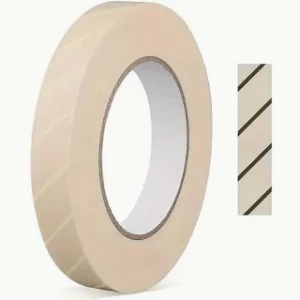
Autoclave Indicator Tape – 12mm x 50m
R358 Add to basket🧫 Medical grade 12mm x 50m Autoclave Indicator Tape
🧫 Lead-free Type 1 indicator strips turn … -
STS
Organic Elephant Garlic Corms (Heirloom)
Original price was: R135.R95Current price is: R95. Add to basket🌱 Start your Elephant Garlic journey.
🌱 Grows into Ajo Macho Solo Round.
🌱 Perennial plant … -
STS
Vermiponic Planter Kit – 5L Passive Organic Hyd...
Original price was: R1,150.R795Current price is: R795. Add to basket🌱Passive | Biological | Ready-to-Grow
🌱Zero Pump| Electricity | Nutrient Cost
🌱 2000ml Verm… -
STS
Pico-Flow CFT | In-Ground Vermicomposter &...
Original price was: R595.R395Current price is: R395. Add to basket🛠 In-Ground Continuous Flow-Through Design Worm Bin
🛠 PicoFlow CFT: Waste Processor & Worm …
Socratic Questions
how to dilute peracetic acid to ppm targetsperacetic acid vs chlorine bleach for lab sterilizationdoes peracetic acid leave a residue on food contact surfacesmixing hydrogen peroxide and vinegar myth busterhow long does peracetic acid spray bottle stay active
Ready to level up your farm hygiene? Visit the SPeS Shop to get your SteriPmax Bettix Bottle.