
Everything begins with the Monera Kingdom – nature’s foundational biological engine.
Before a mushroom colonises its substrate, before a plant absorbs a single nutrient, and before organic matter becomes fertile soil, these microscopic organisms are already at work. Invisible to the naked eye, they ferment, mineralise, recycle, and transform organic materials into the bio-available ionic nutrients and essential enzymes that sustain every living ecosystem. They are the indispensable first step in nature’s circular refinery, making life’s building blocks accessible.

At Eco Bini, we view the Monera Kingdom as the biological engine that powers every closed-loop production system by acting as the primary biological transformer. Rather than replacing biology with chemistry, the Bundu Teq framework is built around cultivating beneficial microbial communities and allowing nature’s own processes to perform the essential, heavy-lifting work of nutrient cycling and decomposition.
Three Kingdoms – One Natural Refinery
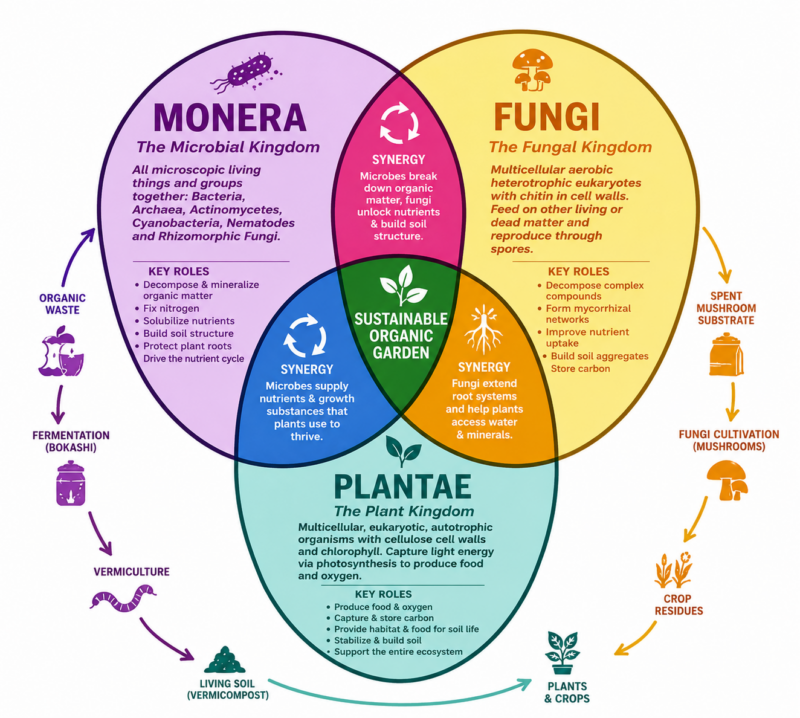
Monera — The Biological Workforce
Monera acts as the essential biological patch cable, bridging nutrient cycles between raw organic inputs and the uptake pathways of Plantae and Fungi. Through processes like N-fixation, mineralization, and fermentation, they make locked-up energy and matter available to higher life forms, enabling closed-loop productivity and system resilience. This kingdom is the primary processor, transforming waste into bio-available fuel.
Fungi — Nature’s Carbon Architects
Fungi are nature’s indispensable carbon architects, uniquely breaking down recalcitrant materials like wood and straw. They unlock vast reservoirs of carbon and stored solar energy, making them accessible to other life forms. Fungi extend biology into places microbes alone cannot reach, forming crucial subterranean networks that facilitate nutrient transport and support plant growth, thereby completing the carbon cycle.
Plantae — The Solar Harvesters
Plants are nature’s primary solar infrastructure, capturing sunlight and atmospheric carbon dioxide to manufacture new biomass. Every leaf, stem, root, fruit, and seed is a product of photosynthesis. This biomass fuels the entire biological cycle, providing the energy and foundation for both Monera and Fungi kingdoms. They are the crucial link converting raw solar energy into usable biological matter.
Together these three kingdoms form a continuous regenerative engine where every output becomes the next biological input.
Engineering the Biological Workforce
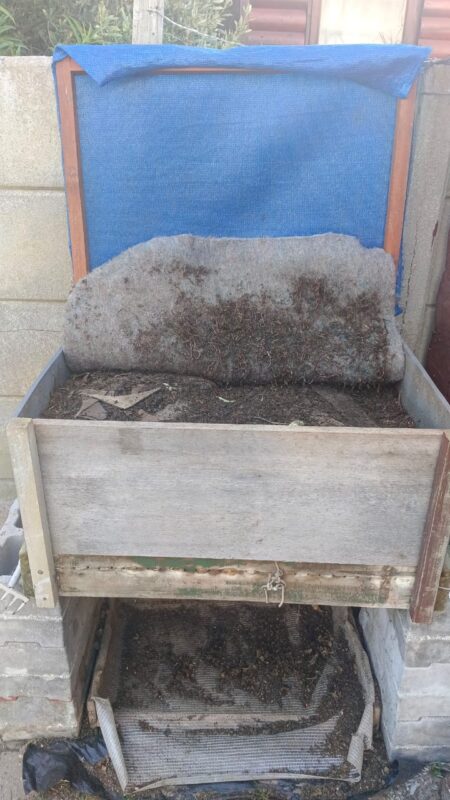
Microorganisms perform the biochemical work, but every workforce requires management in which it can thrive.
Rather than viewing worms simply as composters, the STS regards them as one of nature’s greatest ecosystem engineers. As organic matter passes through the worm gut, microbial communities are concentrated, stabilised and redistributed into biologically active vermicast. The worms continuously engineer the living environment in which beneficial microorganisms flourish.
The microbes perform the work.
The worms engineer the workforce.
This simple distinction changed the way we approached regenerative agriculture.
From Composting to Biological Engineering
Traditional composting asks a simple question:
“How quickly can organic waste disappear?”
The Bundu Teq framework asks a different question:
“How can we engineer biological systems that become stronger with every cycle?”
That shift changes everything.
Organic waste is no longer viewed as something to dispose of. It becomes the raw material from which living biological infrastructure is built.
- Instead of producing compost, we cultivate microbial ecosystems.
- Instead of feeding plants directly, we first feed the biological workforce that supports them.
- Instead of importing fertility, we engineer it.
Four Biological Pistons of the Monera Kingdom
Within the STS, four complementary biological processes work together to build resilient living systems, as evidenced in Terra Preta.
Anaerobic Solid-State Fermentation
Controlled fermentation, including Bokashi and lactic acid fermentation, initiates biological transformation under oxygen-limited conditions. Nutrients are preserved while beneficial microbial communities become established before entering the next stage of the cycle.
Aerobic Vermiculture
Earthworms continue the biological refinement process under aerobic conditions. Their continual engineering of microbial populations produces stable vermicast rich in beneficial biology, plant growth regulators and humus-bound nutrients.
Biological Mineralisation
Plants cannot absorb organic matter directly. The microbial workforce continually converts complex organic compounds into dissolved mineral ions that become available to plants, effectively linking organic waste streams with productive agriculture.
Carbon Infrastructure
Beneficial microorganisms require permanent habitat. Charged biochar provides a stable carbon matrix that protects microbial communities while improving nutrient retention, water holding capacity and long-term soil resilience. Within the STS this became the foundation of the Double-Tap Biochar protocol.
These four processes—Anaerobic Solid-State Fermentation (SSF), Aerobic Vermiculture, Biological Mineralisation, and Carbon Infrastructure—are the biological pistons we utilize to create robust, self-sustaining microbial engine. They work in synergy, transforming organic waste into a stable, nutrient-rich foundation, exemplifying the resilience seen in ancient Terra Preta soils.
The Monera Bridge
The Monera Kingdom serves as the vital interconnectivity layer, the ‘biological bridge’ that links all parts of the Bundu Teq ecosystem. It ensures a seamless flow from organic waste, creating a truly closed-loop system where nothing is wasted.
- Kitchen waste becomes fermented feedstock.
- Fermented feedstock enters vermiculture.
- Vermiculture produces biologically active vermicast.
- Vermicast inoculates fermentation systems, biochar and living soils.
- Plants produce biomass.
- Fungi transform agricultural residues into food.
- Spent mushroom substrate returns to the worms.
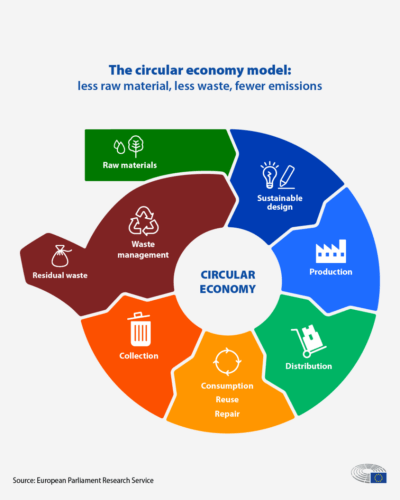
The Monera Kingdom is the cornerstone of our circular economy, ensuring that every biological output—from kitchen scraps to spent mushroom substrate—becomes the next biological input, minimizing waste and maximizing resource efficiency.
It is the optimal circular economy of agricultural waste to food. This continuous cycle forms the biological foundation of Bundu Teq.
STS Research
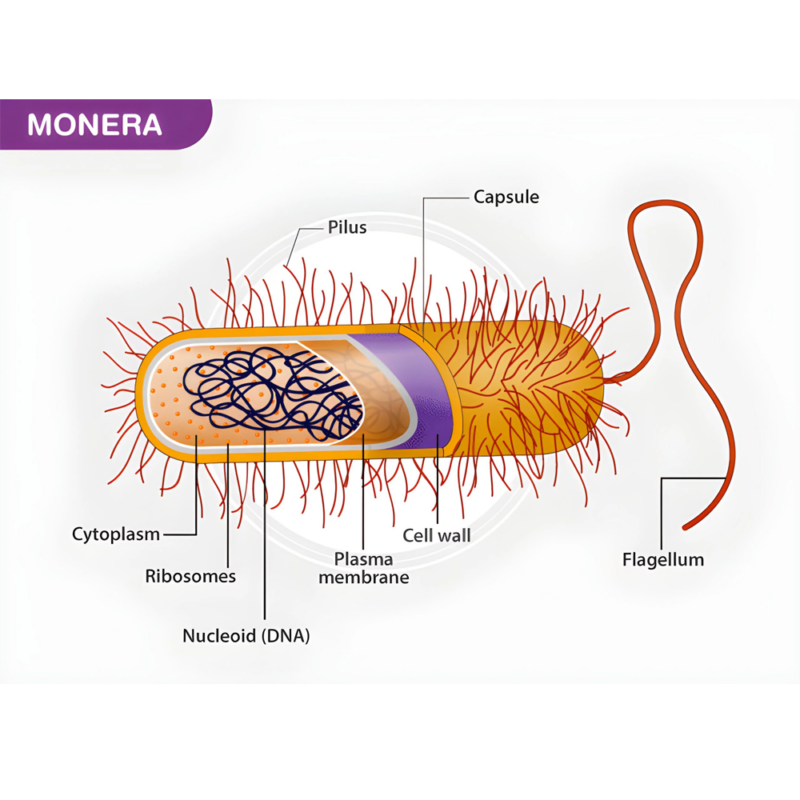
Many of the technologies developed through the Sustainability Testing Station originate from studying the Monera Kingdom and understanding how microbial communities interact with fungi, plants and stable carbon systems.
Protocols such as LAB-X, VermiLIN, Terra Preta Nova, VermiPonics, Bokashi BAM! and the MicroFlow CFT all stem from a single engineering principle:
Healthy ecosystems are built by cultivating biological relationships, not by increasing chemical inputs.
The Monera Kingdom reminds us that the smallest organisms often perform the greatest work. By engineering the conditions in which beneficial microorganisms thrive, we create biological systems that become more resilient, more productive and more sustainable with every cycle.
Closing the Loop: The Horizon Ahead
At SPeS, our journey started with ultra-efficient controlled-environment hydroponics. Then, we integrated mycology because plants require fungal enzymatic action to tap into solid nutrients. But it was only when we unlocked Monera that the invisible link revealed itself.
Worms are the universal translators of the biological world. Once your Tier 1 engine is humming, you are fully armed to progress:
- To Tier 2 (VermiPonics): Route your living soil biome directly into power-free, capillary-wicking sub-irrigated planters.
- To Tier 3 (Fungi Systems): Cultivate advanced molecular mushroom engines, then use the spent substrate to supercharge your Tier 1 bins.
- Back to Bundu Teq Introduction or Our Story.

-
STS
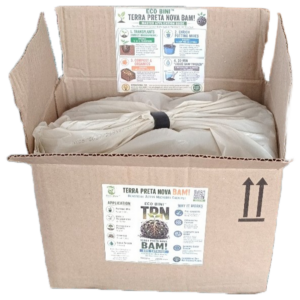
Eco Bini™ Terra Preta Nova BAM! Soil Catalyst | 5 Litre
Original price was: R340.R239Current price is: R239. Add to basket🛠️ Biologically pre-charged Terra Preta Nova Soil Catalyst
🛠️ Premium macadamia shell Granular Activated Carbon (GAC)
🛠️ Beneficial Active Microbes (BAM!)
🛠️ Zero nutrient lockout • Permanent microbial habitat • Ready to use -
STS
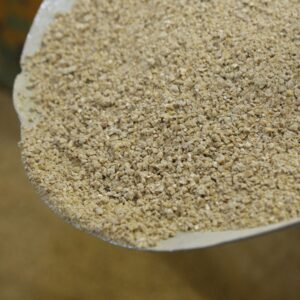
VermiBoost Worm Bin Conditioner | Worm Food (1000ml)
Original price was: R235.R169Current price is: R169. Add to basket🪱 Premium Worm Bin Conditioner for CFT Vermicomposting
🪱 Balanced Microbial Feed with pH Buffer
🪱 Supports Healthy Worm Populations & Stable Composting
🪱 Developed at the Sustainability Testing Station (STS) -
STS

Fermentation Aerator (2.5W) | 40H Backup & NRV
Original price was: R450.R395Current price is: R395. Add to basket🪱 Powerful 2.5W motor with 2.3 L/min output for deep aeration.
🪱 Integrated 18650 Lithium battery: 40H runtime for off-grid use.
🪱 Includes 3m Silicone tubing, Air Stone, and NRV backflow valve.
🪱 Dual Mode: Continuous brew or Pulse-Preserve. -
STS
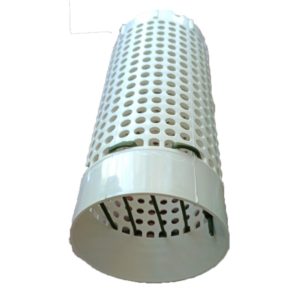
Pico-Flow CFT | In-Ground Vermicomposter & Worm Magnet
Original price was: R1,199.R849Current price is: R849. Add to basket🛠 In-Ground Continuous Flow-Through Design Worm Bin
🛠 PicoFlow CFT: Waste Processor & Worm Magnet.
🛠 UV Resistant | 2500ml Capacity | Screw Cap.
🛠 Including the Vermicompost CFT Manual