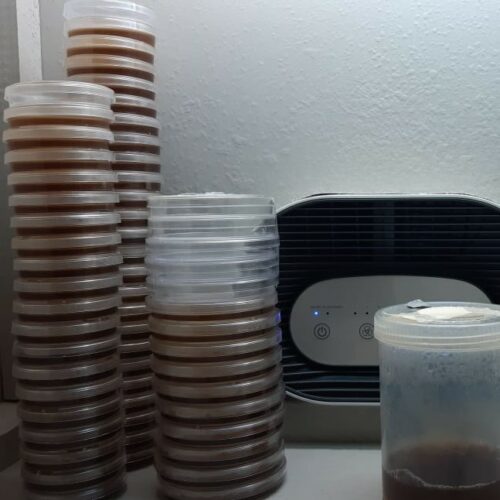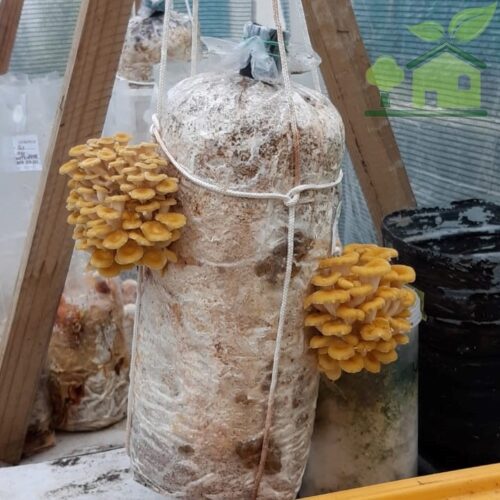
Achieving exact “Field Capacity” is the single most critical factor in preventing anaerobic “wet spot” bacteria and ensuring rapid mycelial colonization. While casual growers rely purely on guesswork, professional cultivation requires an understanding of both tactile field tests and precise gravimetric math. This lab note breaks down the critical windows for grain and bulk substrates, details standard analytical testing options, and provides ready-to-use formulas to hit your target moisture content every single time.
Summary
The Biological Yield: Why Moisture Dictates
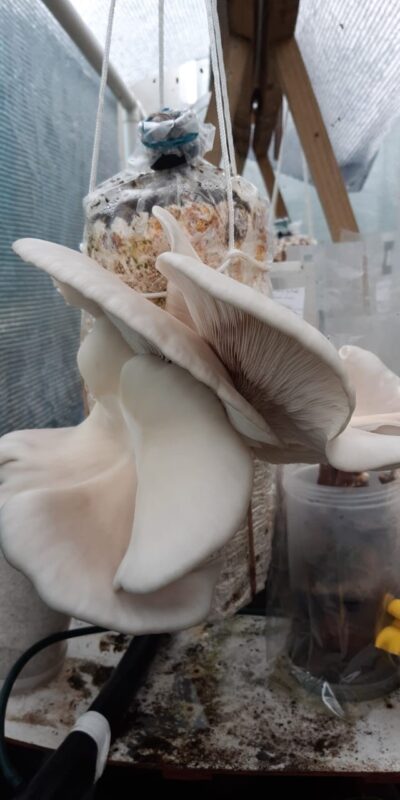
Mushrooms are roughly 90% water by weight. Because fungi lack a root system to pump water over long distances, every drop of moisture required to develop, mature, and yield a heavy flush must be drawn directly from the immediate environment: the substrate and the ambient air.
Imbalanced hydration at any phase of the cycle introduces immediate vectors for crop failure.
1. Mushroom Spawn Hydration
Moisture content controls the rate of early-stage inoculation. The goal is to maximize internal grain hydration while keeping the exterior hull dry and intact. Refer to Lab Prac on making spawn.
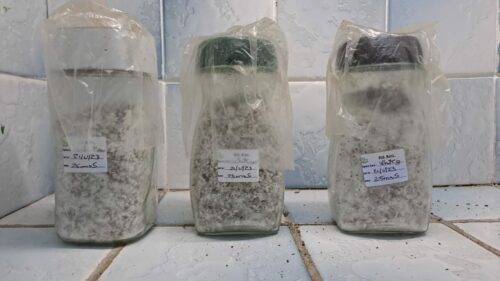
- Over-hydration (“Overcooked” Grain): Excessive surface water breaks down grain structure, turning the kernels mushy. This creates a starchy paste that congeals into an un-shakeable mass. More critically, pooling water at the bottom of a jar or bag creates anaerobic (oxygen-depleted) pockets. This is the ideal breeding ground for Bacillus spp., commonly known as Wet Spot or sour rot.
- Under-hydration: Grains that are dry on the inside cannot support mycelial metabolism. The hyphae will stall, delaying colonization and allowing slower-moving fungal competitor spores to take hold.
Optimal spawn moisture targets vary significantly by grain density and surface-area-to-volume ratios:
- Large Grains: For grains like popcorn, the sweet spot is 49-52% moisture content.
- Small Grains: For grains like sorghum, a moisture content of 42-45% is recommended.
- Tiny Grains: For grains like millet, aim for a moisture content of 30-32%.
2. Bulk Substrate Colonization
Once spawn is transferred to bulk substrate (such as coco coir, sawdust, or straw), moisture governs gas exchange and nutrient transport.
- If the bulk substrate is too dry, the mycelium cannot secrete the extracellular enzymes needed to break down lignin and cellulose. Growth slows to a crawl.
- If it is over-saturated, water fills the microscopic air voids within the substrate matrix. This suffocates the aerobic mycelium and invites aggressive molds (Trichoderma) and bacterial competitors.
3. The Fruiting Phase & Ambient Air
During the pinning and fruiting stages, moisture acts as both a physical trigger and a structural resource.
- Substrate Exhaustion: A substrate that enters the fruiting chamber under-hydrated will yield small, stunted fruit bodies or abort the pins entirely before they reach market size.
- Ambient Relative Humidity (RH): The air in your fruiting room should ideally be stabilized at 80% to 85% RH.
The Pinning Paradox: Keeping a grow room at 100% constant saturation actually stalls pinning. Dropping the ambient air slightly below total saturation (to 80-85% RH) allows subtle evaporation to occur on the substrate surface. This minor evaporative cooling is a primary biochemical signal that tells the mycelium it has reached open air, triggering pinhead development. Furthermore, keeping RH below 90% prevents standing water from settling on the caps, reducing the risk of bacterial blotch.
Analytical Tools vs. Field Testing
Cultivators use a range of methods to evaluate substrate moisture, balancing laboratory precision against practical speed.
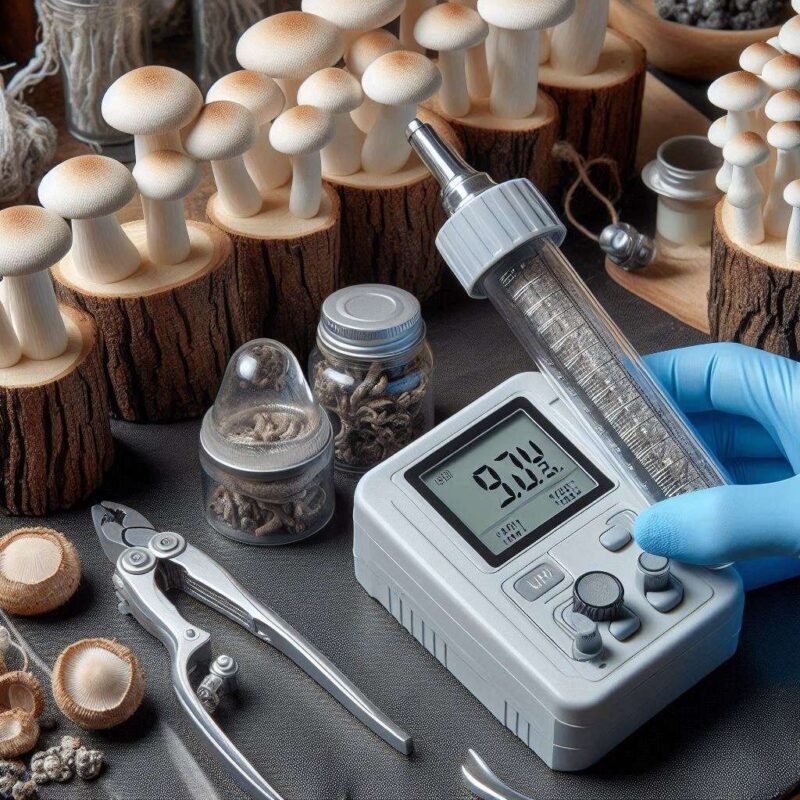
Handheld Moisture Meters (Resistance & Capacitance)
These devices offer instant, on-the-spot readings by passing a minor electrical current through the material or measuring its dielectric properties. While highly efficient for fast checks in large commercial operations, their accuracy depends heavily on density. A loosely packed substrate will read differently than a tightly compressed block of the exact same moisture content. Regular calibration against a known dry standard is mandatory.
Near-Infrared Spectroscopy (NIRS) & Infrared Analysers
Infrared moisture balances use a built-in heating element to dry a small sample quickly while measuring mass loss via light absorption characteristics. NIRS goes a step further, using non-destructive light reflection to assess chemical bounds. Both provide rapid, high-accuracy data, but the initial capital expense limits them to commercial operations and advanced laboratories.
Karl Fischer Titration
An advanced chemical analysis method that determines water content through iodine reaction. It is highly precise and capable of identifying trace moisture levels, but it requires specialized laboratory reagents and equipment, making it impractical for daily farm workflows.
The Low-Tek Farm Standard: The Squeeze Test
For small to mid-scale cultivators, the manual “Squeeze Test” remains the most functional daily tool for assessing Field Capacity (the maximum amount of water a substrate can retain without waterlogging).
- The Test: Take a firm handful of fully prepared, mixed substrate and squeeze it tightly.
- The Target: The substrate should hold its shape without crumbling when you open your hand. Your knuckles should feel wet, and exactly 2 to 3 drops of water should escape under maximum squeeze pressure.
- If a stream of water runs down your wrist, it is over-saturated.
- If no drops escape and the material springs apart loosely when you release your grip, it is under-saturated.
While highly intuitive, the squeeze test is fundamentally subjective. To back it up with empirical numbers, you must use Gravimetric Analysis.
The Mathematics of Moisture: Gravimetric Analysis
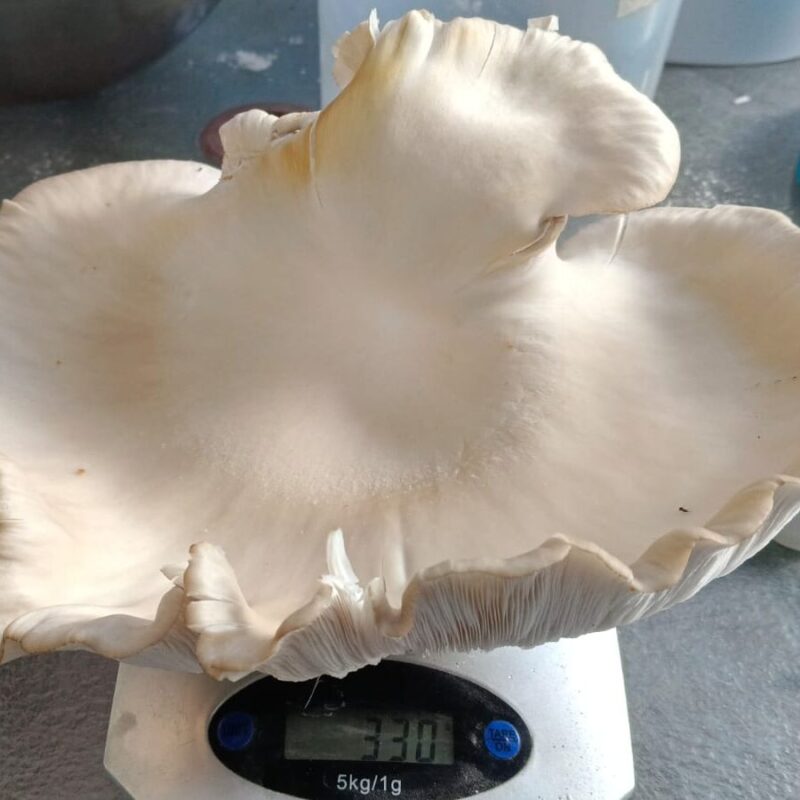
Gravimetric analysis is the empirical baseline used to calibrate every electronic sensor on the market. It relies on a simple premise: weigh a wet sample, drive off 100% of the water via heat, weigh the bone-dry mass, and calculate the difference.
The Standard Oven Method
- Weigh a clean, heat-safe container.
- Add a representative sample of wet substrate and record the Initial Wet Weight (W1).
- Place it in an oven set to 105°C (221°F) until it reaches a completely constant mass (typically 12 to 24 hours), ensuring all water has evaporated without scorching the organic matter.
- Weigh the dry sample to find the Final Dry Weight (W2).
The Rapid Microwave Method
If you do not have an oven that accurately holds a low 105°C setting, a standard kitchen microwave serves as an excellent, rapid alternative.
Step-by-Step Microwave Protocol:
- Sample Preparation: Weigh out exactly 100g of your wet substrate sample on a precise digital scale. This makes the math simple. Record this as Initial Weight (W1).
- Safety Sync: Place the sample in a microwave-safe bowl. Crucially, place a separate cup of cold water inside the microwave chamber next to your sample. This acts as a thermal ballast to absorb excess microwave energy and prevents your dry organic substrate from catching fire.
- Initial Burst: Run the microwave on High for 2 to 3 minutes to drive off the bulk of the surface moisture.
- Cool & Weigh: Remove the sample, let it cool for 60 seconds (so rising steam doesn’t skew your scale reading), and record the mass.
- Incremental Cycles: Return the sample to the microwave and run it in 1-minute intervals on Medium-Low power. Weigh it after each cycle.
- Determine Bone-Dry Mass: The moment the weight stops changing between consecutive cycles, all water is gone. Record this stable final value as your Final Dry Weight (W2).
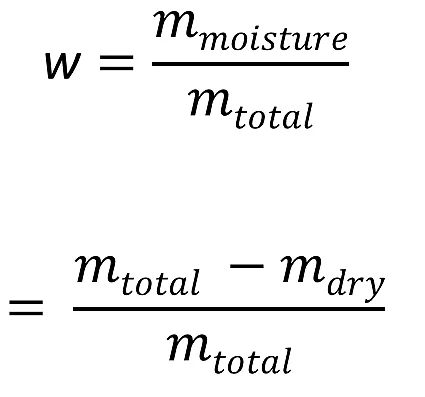
The Master Moisture Formula
To find your current moisture percentage, use this formula:
Moisture Content (%) = [(Initial Wet Weight – Final Dry Weight) / Initial Wet Weight] x 100
Here, (W1) is the initial weight, and (W2) is the final constant weight after drying.
Real-World Cultivation Scenarios
Scenario A: Accounting for Residual Moisture in Raw Grain
A common amateur mistake is assuming that raw, dry grain out of a commercial sack contains 0% water. In reality, all seed grains retain around 10% to 14% atmospheric moisture to keep the internal germ alive. If you ignore this baseline moisture, your final hydration math will be significantly skewed.
Example Problem: You scale out 2000g of raw sorghum from a bag that has a verified baseline moisture content of 12%. After boiling and draining, your total hydrated grain mass rises to 3250g. What is your exact new moisture content?
The Math Walkthrough:
- Find the starting water mass: 2000g raw grain x 0.12 baseline moisture = 240g of water already in the bag.
- Find the absolute dry matter mass: 2000g total – 240g water = 1760g of bone-dry matter.
- Analyze the hydrated state: Your total post-hydration mass is now 3250g. The dry matter never changes; it is still 1760g.
- Find the new water mass: 3250g total – 1760g dry matter = 1490g of total water.
Apply the master formula to find the final percentage:
- Moisture Content (%) = (1490g water / 3250g total weight) x 100
- Moisture Content (%) = 0.45846 x 100 = 45.85%
The Cost of Guesswork: If you had assumed the bag started at 0% moisture, your quick calculation would have incorrectly told you the grain was at 38% moisture. By accounting for the raw grain’s storage moisture, you know you are actually sitting at a near-perfect 46% for your small grains.
Scenario B: Calculating Exact Water Addition for Substrate Pellets
Commercial processed materials (like soy hulls or hardwood fuel pellets) come pre-dried to a specific manufacturer baseline—typically 10% moisture. This consistency makes them incredibly easy to work with once you master the target hydration formula.
Example Problem: You start with 2000g of hardwood pellets at a packaging moisture content of 10%. Your goal is to supplement and hydrate this batch to hit a flawless bulk substrate field capacity of 60% moisture. How much water do you need to add?
The Step-by-Step Breakdown:
- Find the dry matter: 2000g of pellets x 10% baseline water = 200g of initial water. This means your raw pellet batch contains exactly 1800g of dry matter (2000g – 200g).
- Project the target weight: At a target of 60% moisture, your final substrate block must consist of 60% water and 40% dry matter.
- Because your dry matter mass is a fixed constant (1800g), we can calculate the final total mass required by dividing the dry matter by its target percentage:
- Target Total Mass = Dry Matter Weight / (1 – Target Moisture Percentage)
- Target Total Mass = 1800g / 0.40 = 4500g total weight.
- Calculate water to add: Subtract your starting pellet weight from your target total weight:
- 4500g total target – 2000g starting pellets = 2500g of water.
The Shortcut Water Calculation Formula
To skip the multi-step derivation, you can use this consolidated linear equation to figure out water additions for any dry pellet batch:
Water Mass to Add = [(Target MC – Pellet MC) / (100 – Target MC)] x Mass of Dry Pellets
Where:
- Target MC = The final moisture content percentage you want to achieve (e.g., 60)
- Pellet MC = The packaged baseline moisture percentage of the pellets (e.g., 10)
- Mass of Pellets = The starting weight of the un-hydrated pellets in grams
Testing the Shortcut:
- Water Mass = [(60 – 10) / (100 – 60)] x 2000
- Water Mass = [50 / 40] x 2000
- Water Mass = 1.25 x 2000 = 2500 grams of water.
By running this linear formula prior to mixing, you completely eliminate batch variability, dial in field capacity effortlessly, and guarantee uniform, high-yielding flushes across every single crop cycle.
-

Yellow Sticky Fruit Fly & Fungus Gnat Traps
R11 Select options This product has multiple variants. The options may be chosen on the product page🏗️Bright yellow colour attract flying insects
🏗️Odourless, Safe and Non-toxic
🏗️Durable – UV resistant and Waterproof
🏗️Easy to Use, Plant and Peel -
Potato Grow Bag – Heavy Duty (38L) with Harvest Flap
R149 Add to basket🌱 Grow Potatoes anywhere!
🌱 UV-resistant 38L bag with easy-harvest flap.
🌱 Reinforced handles, and aeration holes.
🌱 Ideal for small urban spaces. -
STS
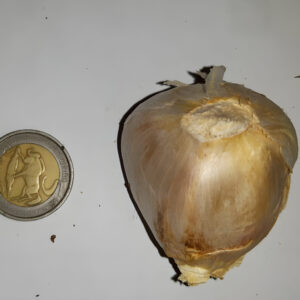
Organic Elephant Garlic Cloves – Vernalized
Original price was: R695.R495Current price is: R495. Add to basket🌱 Large, mild-flavoured cloves
🌱 10 Elephant Garlic Organic seeds
🌱 Vernalized for immediate planting
🌱 Seasonal – limited Stock -
STS
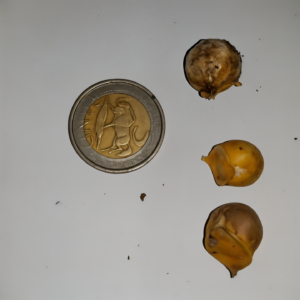
Organic Elephant Garlic Corms (Heirloom)
Original price was: R135.R95Current price is: R95. Add to basket🌱 Start your Elephant Garlic journey.
🌱 Grows into Ajo Macho Solo Round.
🌱 Perennial plant and natural pest deterrent.
🌱 Limited Stock – 20 off per pack
Socratic Questions (5 Search Terms):
- How do I calculate “Field Capacity” for mushroom substrates?
- What is the ideal moisture content for sawdust vs. straw?
- How to prevent “wet spot” (bacillus) in grain and sawdust spawn?
- Does my substrate need more water? (The Squeeze Test guide)
- Mathematical formula for adjusting moisture in dry mushroom bulk?