
Research Nature’s Refinery with Ed Eco
Ed Eco is the Lead Biological Engineer and Knowledge Mentor for the Bundu Teq Knowledge Base.
He draws on the Sustainability Testing Station (STS) research library, practical experiments and the evolving Bundu Teq framework to help growers understand biological systems, troubleshoot problems and explore Engineering Biological Independence.
What ecological process originally performed this function?
That is the question behind Bundu Teq — and the starting point for Ed Eco’s reasoning.
Ask Ed Eco
Have a question about your growing system?
Ask Ed about:
🌱 Plantae — plants, soil, nutrients, hydroponics and biological fertility
🦠 Monera — microbes, fermentation, LAB, Bokashi and nutrient unlocking
🍄 Fungi — mycology, substrates, spawn and fungal ecology
🪱 Vermiculture — worms, vermicast and biological processing
♻️ Circular Systems — composting, biochar, waste-to-resource systems and closed-loop production
Ed Eco is the BTK Curator, trained directly on STS research.
Ask him anything—from troubleshooting plant issues to engineering biological independence.
What is Bundu Teq?
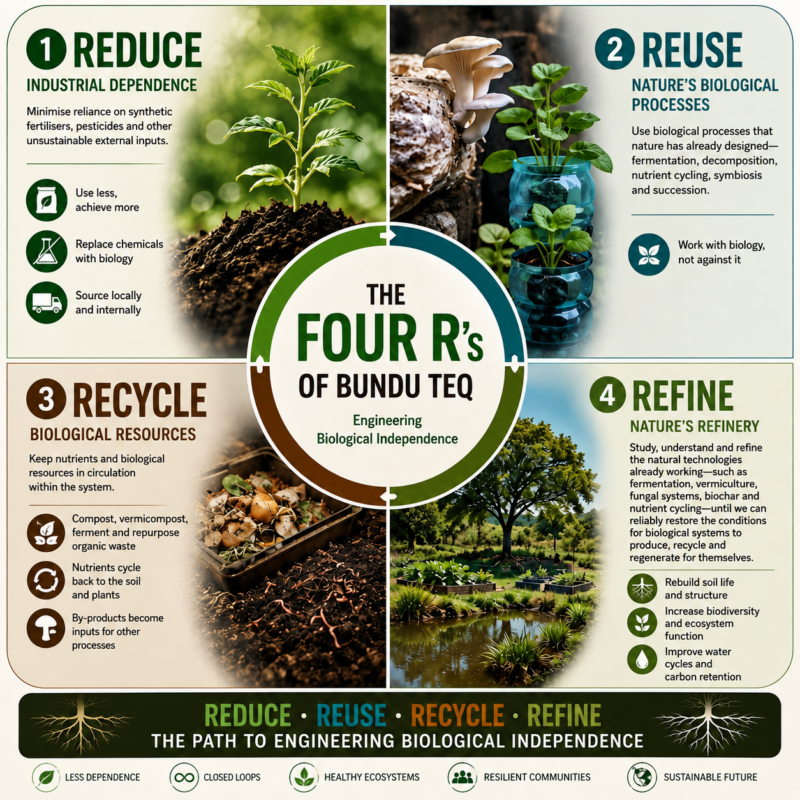
Bundu Teq is a biological engineering framework for Engineering Biological Independence.
Rather than replacing biological processes with industrial inputs, Bundu Teq asks how nature performs a function — and then seeks to understand, restore and refine that process.
Its guiding principle embodied in;
The Four Rs:
Reduce – dependence on industrial inputs.
Reuse – nature’s biological processes.
Recycle – biological resources and keep nutrients within the system.
Refine – knowledge to restore Nature’s Refinery.
🔄 The Three Paradigm Shifts for Sustainable Agriculture
PS #1: Plant-Available Nutrients
Old Thinking: Plants feed directly on compost.
New Reality: Plants cannot directly absorb organic matter. The Soil Biome first mineralizes it into water-soluble nutrients — the foundation of regenerative agriculture and VermiPonics.
PS #2: Pasteurizing Bio-Engineers
Old Thinking: Worms eat decomposing organic scraps.
New Reality: Worms do not consume waste directly — they feed on the decomposing microbial soup, biologically pasteurizing organics into stable vermicast rich in BAM!, enzymes, growth hormones and nutrients.
PS #3: Selective Nutrition
Old Thinking: Contamination is a sterility problem.
New Reality: Contamination is a nutrition problem – by pre-digesting nutrition through Monera systems, we create fungal substrates where gourmet mycelium thrives while contaminants remain locked out.
Explore the BTK
The BTK is not a static textbook – It is an evolving knowledge system based on practical work done at the STS (Sustainability Testing Station.)
As new experiments are performed, crops grown, or new relationships discovered and existing ideas refined, the knowledge base evolves through the STS Lab Notes.
You don’t have to know the terminology – ask the question in your own words.
Ed Eco will help connect the question to the underlying biological process and, where relevant, to the research, practical work and resources contained within the BTK.